Looking at a painting, as Cecily Brown says, is not something you can rush; it is like taking your eye for a walk. In her exhibition at Serpentine South, though, that walk feels anything but leisurely.
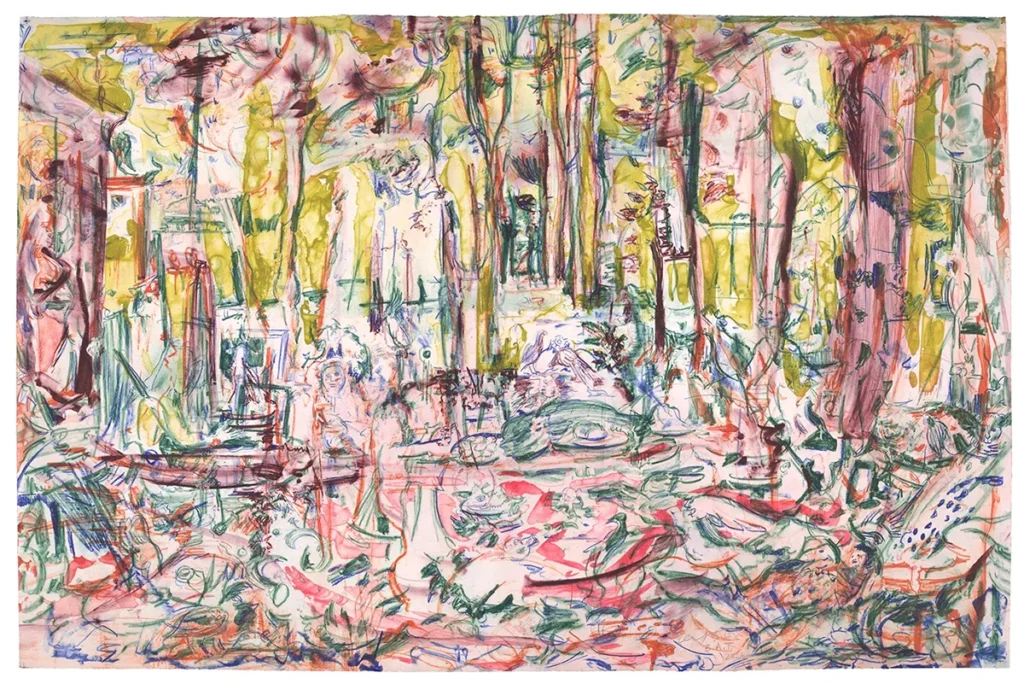
At first glance you see a forest, a lake, a calm English landscape. Look longer and the image starts to disagree with itself: forms fade into one another, and a deer’s body carries a head that seems to look in two directions at once.
Flesh, Paint, and Provocation: Why Cecily Brown Is Famous
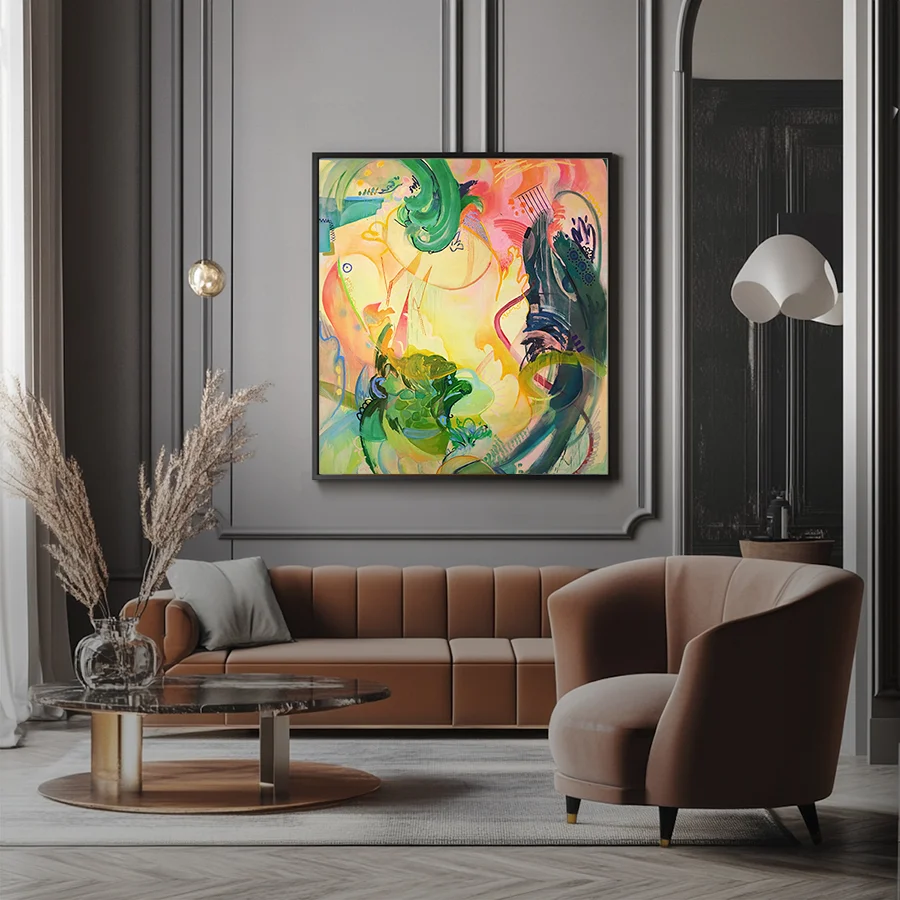
The instability is the point. Brown’s canvases catch the eye first with energy: brushstrokes that refuse to settle at a single scale, shifting within the same painting from an intimate, close-up passage to something expansive and monumental. The eye never gets to rest at one fixed distance from the work.
The paintings play a related game with legibility. Figures surface out of the dense paint, then dissolve back into it, so the same picture can read as a specific scene one moment and pure abstraction the next, depending on how long you stand in front of it.
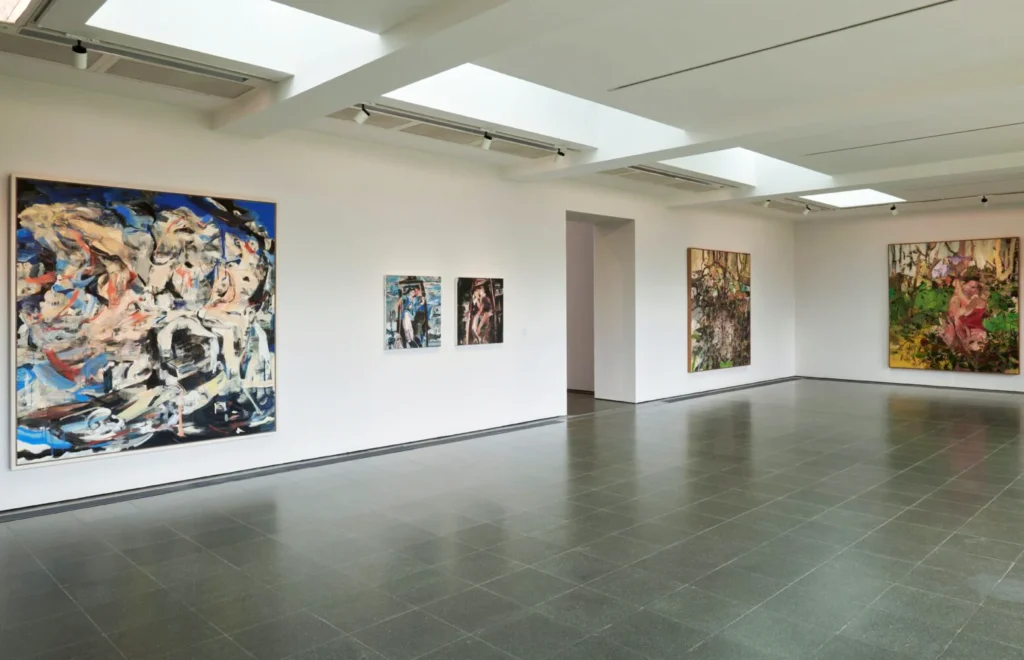
Cecily Brown: Picture Making is the artist’s first major show in London after thirty years in New York, and it turns her childhood landscape into something uncannily familiar and strange at once. That willingness to sit inside disorder is a large part of why she occupies such a central position in contemporary art. She recreates traditional painting through a contemporary lens, holding continuity and transformation together rather than choosing between them.
A British Painter Learning to Paint Against the Grain
Brown graduated from the Slade School of Fine Art in 1993, just as the Young British Artists were reshaping the English art scene through conceptual work, media visibility, and provocation. She went the other way, staying with painting as her primary language, a choice that set her apart from most of her contemporaries.
It paid off commercially: Brown became recognized as one of the best-selling female painters of her generation. But that success never softened the work itself. She kept depicting the body as fragmented, excessive, and often ambiguous in gender, in a market that historically valued female painters far less than their male peers.
Brown has described what she is after as something like a word on the tip of your tongue, felt but not yet nameable. She calls painting an intermediate, substitute reality: a testing ground where the struggle stays legible to her even if the finished canvas is meant to hide all trace of it.
Cecily Brown in New York: The Return to the Figure
She moved from London to New York in 1994, a move that shaped everything that followed. The New York scene offered room for a fresh take on figurative painting, and Brown began to be mentioned alongside painters like John Currin as part of a broader return to the figure, significant precisely because it arrived in an era when painting’s relevance was being openly questioned. She has lived and worked in New York ever since.
Her output has been relentless since the 1990s. The early work leaned hard into erotic intensity and physical presence; later, the concerns widened toward memory, mortality, and the sense of time as something without clear edges. Despite that shift, her work has never settled into an easy category. It stays historically grounded and visually immediate at once, and that tension is close to a defining feature of her practice.
Cecily Brown Paintings and Drawings, Three Decades in Major Institutions
Brown’s rise was fast. By the late 1990s her work was already appearing in major exhibitions and collections, setting the terms for the three decades that followed. Drawing turned out to matter as much as painting to how she thinks, made explicit in 2016 with Rehearsal at New York’s Drawing Centre, and confirmed internationally in 2018 with a comprehensive survey at Denmark’s Louisiana Museum of Modern Art and a show at São Paulo’s Instituto Tomie Ohtake the same year.
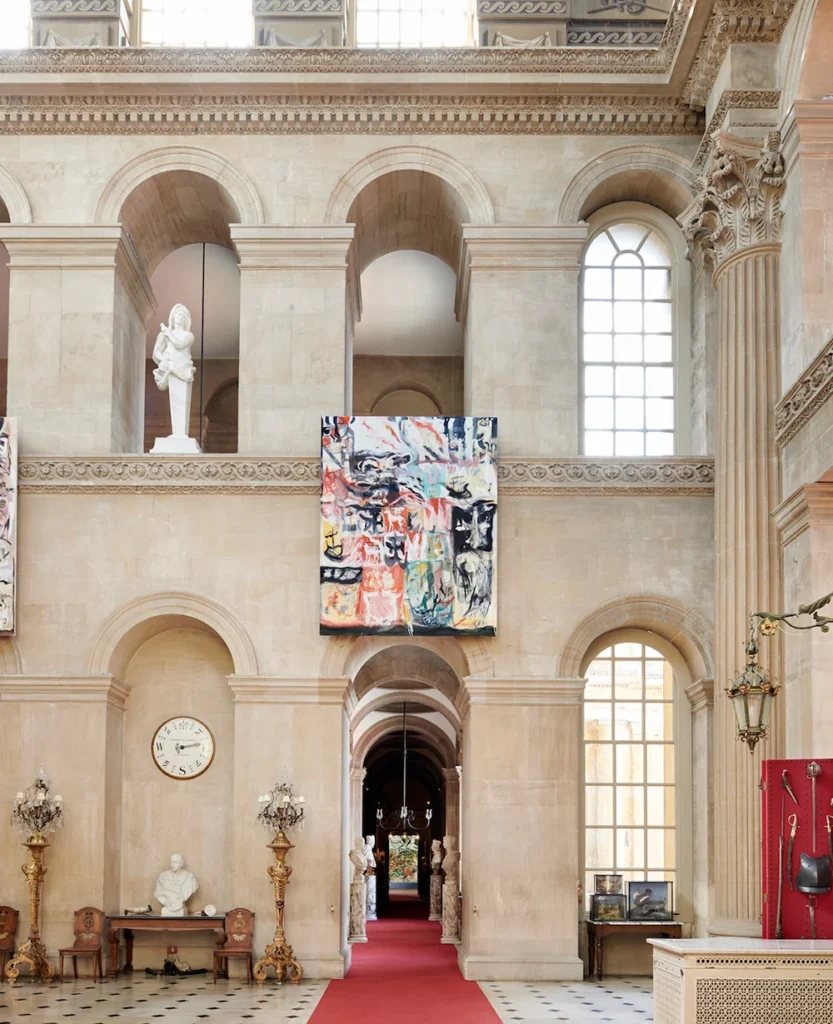
In 2020, an exhibition at Blenheim Palace pushed the idea further. Her paintings had to hold their own against the physical weight of the building itself, and that friction between architecture and painting became the substance of the show.
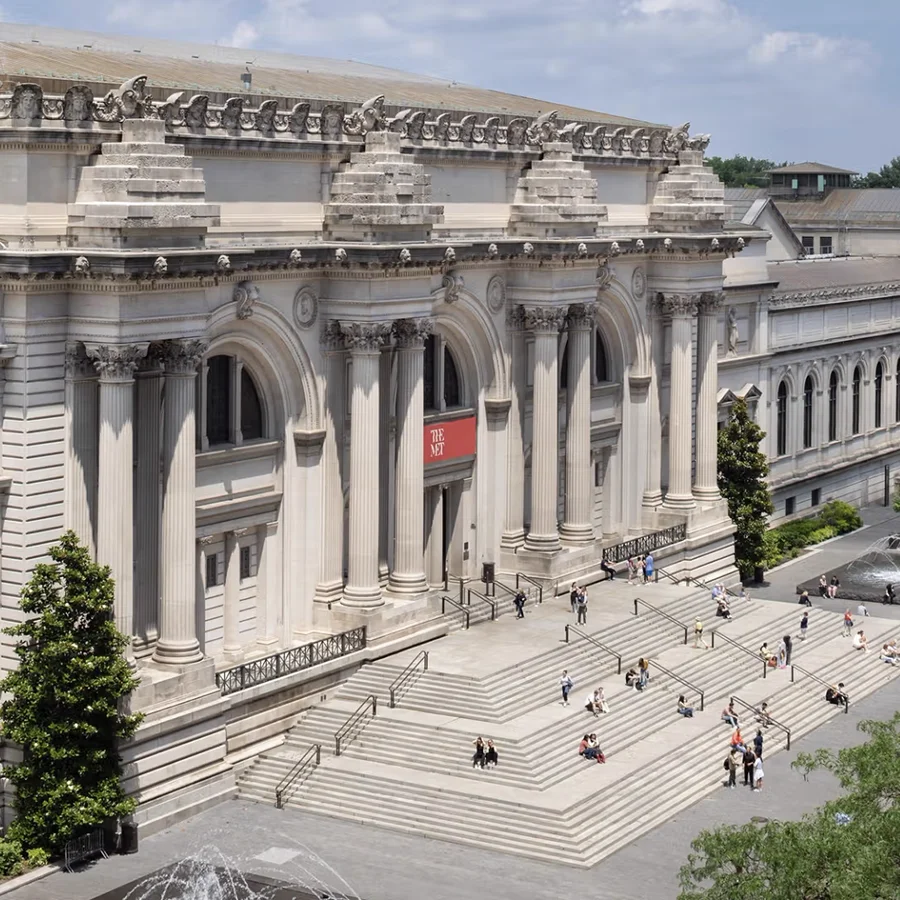
Mortality moved to the centre of the work by 2022, with exhibitions at Munich’s Pinakothek der Moderne and, in Naples, The Triumph of Death at the Museo di Capodimonte. A year later, Death and the Maid at the Met, her first large-scale New York survey, pulled together roughly fifty works across painting, drawing, and monotype, all circling the same preoccupations: mortality, mirrors, vanitas.
Themes and Variations (2024 to 2025), a joint production with the Dallas Museum of Art and the Barnes Foundation, became her biggest US outing yet, tracing how her visual language had developed without ever losing its grip on art history.
Cecily Brown's Art Style: Myth, Desire, and the Body That Will Not Hold Still
Underneath their pastoral surface, Brown’s landscapes run on a mythological logic. Critics have traced classical mythology through her work consistently, a framework that lets trees and bushes take on human or animal form, and lets interior and exterior space bleed into each other almost without seam.
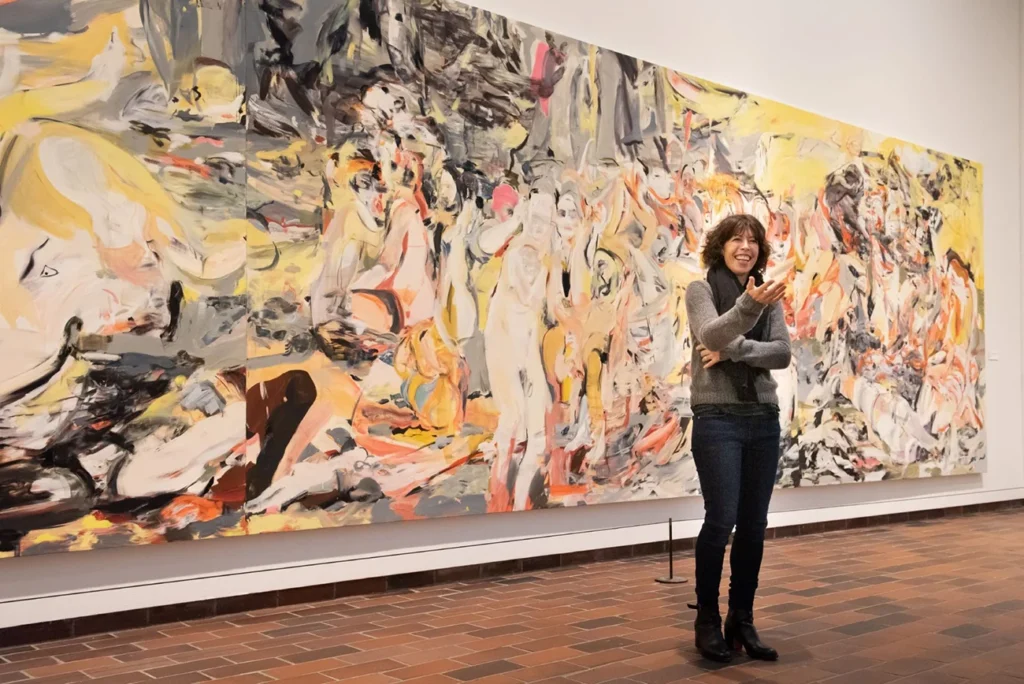
Sexuality, in this framework, stops being a subject and becomes something enacted in the paint itself, a different register of repression. In early canvases like Couple, the bodies interpenetrate so completely that the figures nearly vanish into the surrounding greenery; urgency overtakes anatomical precision, etched onto the canvas in fast, charged brushstrokes. Desire here is not something you register at a glance. It is defined by motion and heat, and it stays that way across three decades of work as one of Brown’s most consistent points of reference. The body, in her hands, never holds still long enough to be simply looked at.
That restlessness comes from her method as much as her subject matter. Brown works several canvases at once, often at different sizes, which keeps the process physical and intuitive rather than planned in advance. Paint goes on, gets scraped back, gets reworked over long stretches of revision. Accidents and unplanned marks are left in rather than corrected out. The finished canvas is not a single decision; it is the accumulated residue of many.
Coming Home: Picture Making at Serpentine South
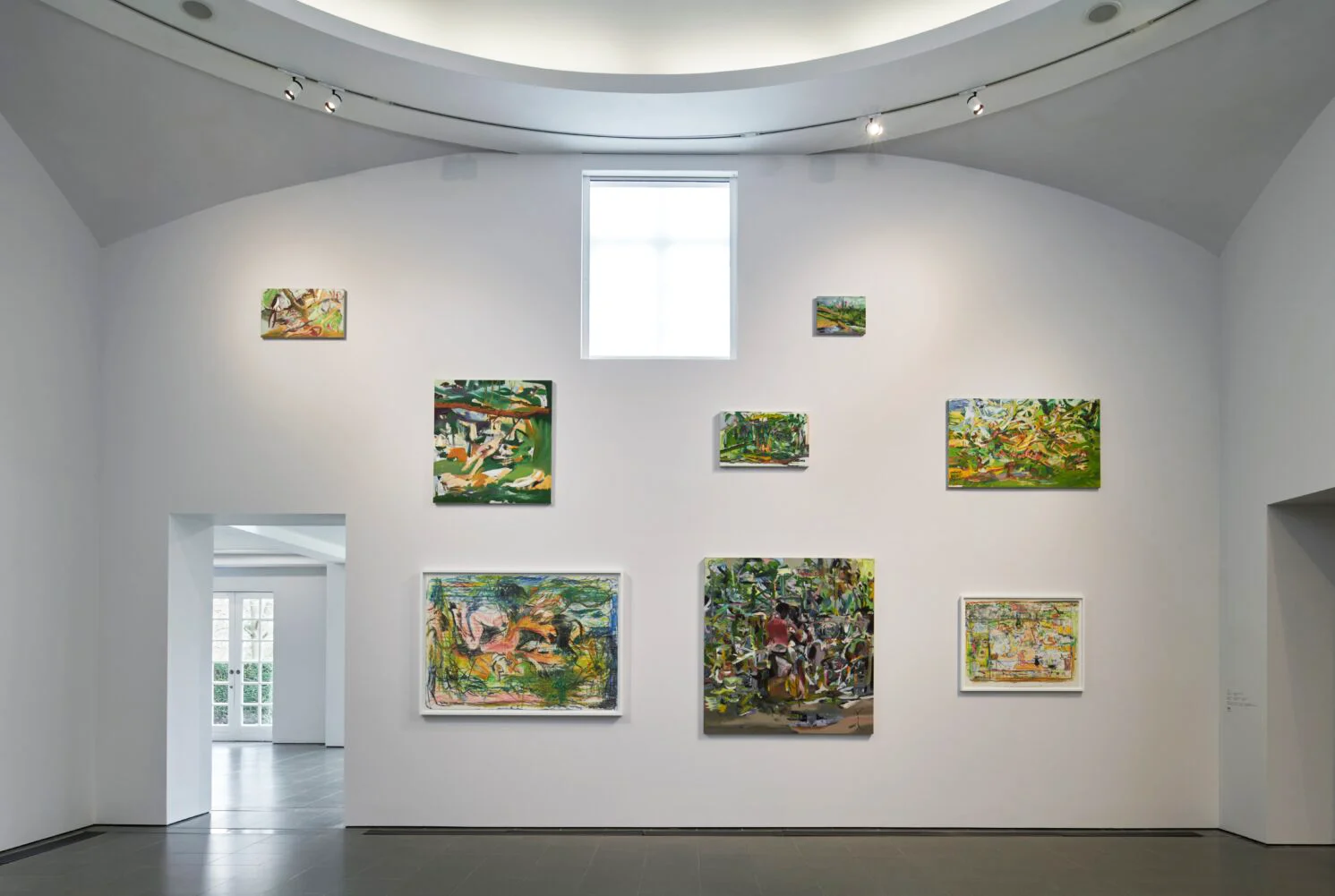
In 2026, she returned to London. Picture Making at Serpentine South is her first solo painting show in a UK public institution in over twenty years, and it puts new and old side by side: fresh paintings evoking the English countryside hang alongside illustrations from children’s books and earlier works like Bacchanal (2001) and Couple (2003 to 2004).
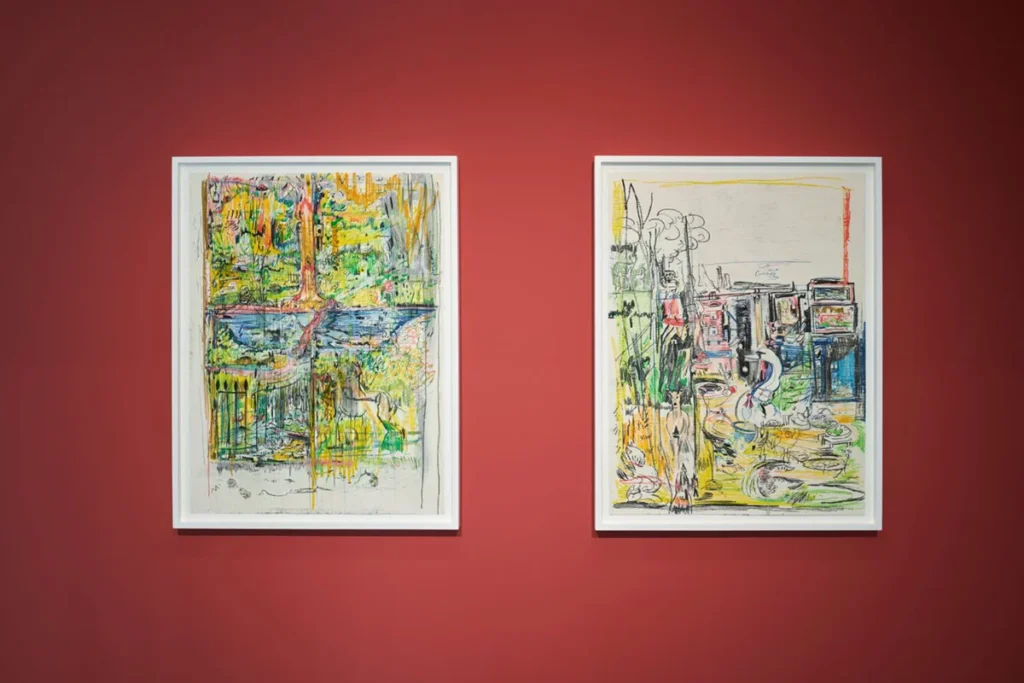
Among the new pieces, one image recurs most: a log crossing a stream, reworked repeatedly in different colours, sizes, and tones, less a motif than a question Brown keeps returning to without resolving. Calling it decoration would miss the point; that cycle of repetition is the exhibition’s actual subject.
The show itself resists being read as a simple string of related images. It brings together thirty-two paintings and twenty-three drawings spanning more than two decades, including a newer set of ink drawings drawn from beloved British children’s-book illustrators: Beatrix Potter, the Ladybird series, Kathleen Hale’s Orlando the Marmalade Cat.
Critical response has split. Some call it one of the defining cultural moments of the London art season and Brown one of the most influential British artists of her generation. Others are harsher, arguing the nature-walk paintings tip into decorative jumble, and that Couple, made more than twenty years ago, still outclasses everything new in the room.
Either way, the recurring images that run through thirty years of Brown’s work are not a tic or a static cliché. They read more as a set of questions she has not finished asking. The log across the stream at Serpentine South belongs to that older habit, returned to not to be finally understood, but to be tested again. That, in the end, may be the closest thing to a single purpose across Cecily Brown’s paintings: the mystery in the work only gives anything up if you keep looking.