For over two decades, My Bed (1998) by Tracey Emin has been one of the most talked-about and debated works of contemporary art. Is it a self-portrait or a profound exploration of human vulnerability? Its fame reflects Emin’s distinctive approach: intensely personal, emotionally raw, and unapologetically candid.
Early Life and Career
Tracey Karima Emin was born on July 3, 1963, in England. She studied fashion at Medway College of Design (1980–82) but did not complete the degree, then pursued printmaking at Maidstone Art College (1983–86), and later earned her MA in painting from the Royal College of Art in 1989.
Over the course of her career, Emin has worked across a wide range of mediums, including painting, drawing, sculpture, textiles, print, film, photography, and less conventional forms such as neon text. Active since the 1990s, she has repeatedly shaken the art world with work that intensely magnifies her emotional and psychological experiences.
Emin is associated with the Young British Artists (YBAs), alongside Damien Hirst and Sarah Lucas, a group known for shock tactics, entrepreneurial spirit, use of disposable materials, and a interesting lifestyle. Their approach challenged the art establishment, blending oppositional critique with commercial savvy.
Exploring Identity, Trauma, and Femininity
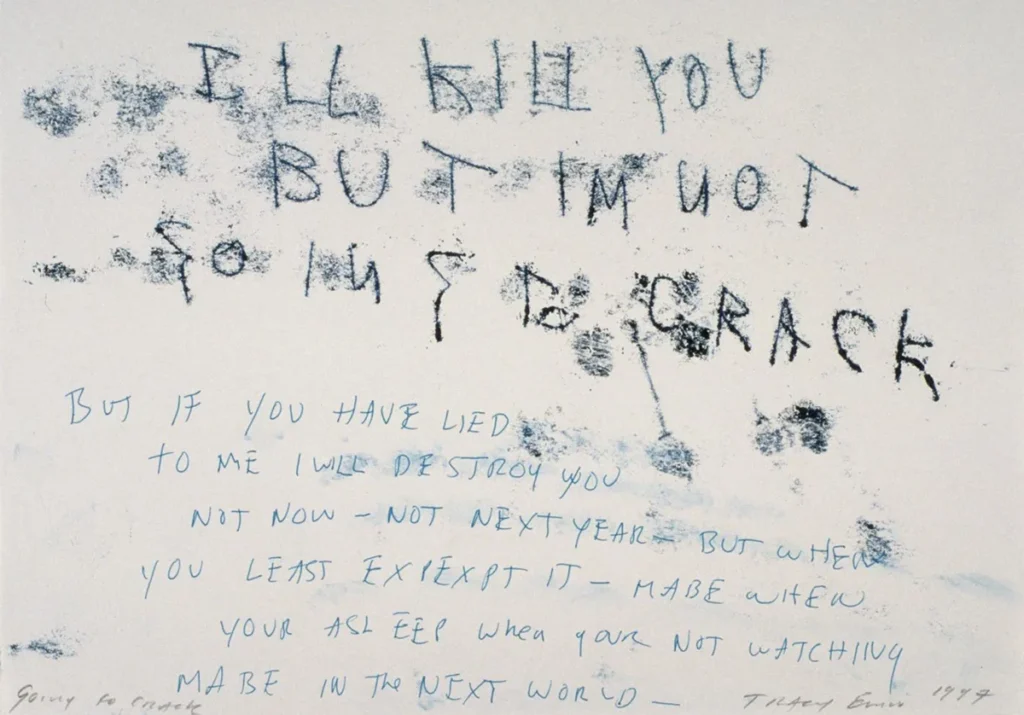
Emin’s aesthetic is characterized by text, found objects, and raw materials. Handwritten notes, neon signs, and everyday objects frequently appear, creating an emotional bridge between her life and her art. Identity, trauma, love, grief, and the feminine experience are recurring subjects.
By revealing her struggles with relationships, mental health, and her body, Emin dissolves the barrier between artist and viewer. Her work turns personal storytelling into a universal language, showing how vulnerability can illuminate the human condition. Her recurring, often shocking motifs invite reflection on love, loss, and the consequences of life choices.
Her ability to depict both deeply personal and universal emotions has broader implications for contemporary art. Emin demonstrates that personal experience can drive aesthetic expression, challenging the idea that art must be removed from the artist’s life to be meaningful.
The Story Behind My Bed (1998)
Emin rose to fame when My Bed was exhibited at the 1999 Turner Prize. The installation follows the tradition of “anti-art,” exemplified by Marcel Duchamp’s Fountain (1917), and relates to the use of found objects in modern art, from Picasso’s Cubist collages to Henry Moore’s sculptures. Salvador Dalí also altered found objects, illustrating the long lineage of artists using everyday materials to challenge notions of value and meaning.
The piece emerged after a period of depression following a difficult breakup. Emin had spent weeks in bed, and upon finally leaving it, realized the scene itself was a work of art. She displayed her unmade bed, surrounded by crumpled tissues, period-stained clothing, cigarette butts, empty vodka bottles, a pregnancy test, condoms, and lubrication.
The installation presents the aftermath rather than a literal snapshot of her life. Viewers encounter a montage, a visual story rather than the “truth” of the moment. The artist herself is absent, leaving only a raw representation of her emotional state. Critics and audiences are invited to imagine her presence and the lived experience behind the objects, engaging with the tension between reality and artistic interpretation.
How My Bed Changed Contemporary Art
Over time, My Bed has become a diary-like record of emotional struggle and resilience. When viewers encounter it today, it feels like reading the intimate story of a young woman whose life has since transformed.
The work confronted societal taboos around women’s vulnerability and sexual desire. Emin’s openness about sex and mental health set a new standard for British art in the late 1990s. Though theatrical, the work is meticulously curated: used condoms, cigarette butts, K-Y Jelly, tissues, and shoes are arranged deliberately, transforming everyday “trash” into figurative sculpture.
The installation sparked controversy. Critics decried it as immoral or self-indulgent. Some called it a sign of the end of civilization, feminism, or art itself. Others dismissed it as a blatant bid for attention. Despite this, collectors and museums embraced its significance. Charles Saatchi purchased My Bed for £150,000 and sold it in 2014 for £2.2 million, demonstrating both its artistic, cultural, and financial impact.
Emin’s work also emphasizes the role of meticulous presentation in conceptual art. Each time My Bed is exhibited, the artist carefully arranges the items herself, from crumpled sheets to cigarette butts. This attention to detail underscores the blend of chance, autobiography, and artistic intention, elevating the installation beyond mere spectacle.
Tracey Emin Today
Emin’s accolades reflect her influence and long-standing contribution to contemporary art. She represented the UK at the 52nd Venice Biennale (2007), became Professor of Drawing at the Royal Academy (2011), received a CBE (2012), created The Doors (2023) for the National Portrait Gallery, and was named a Dame in 2024. Each milestone highlights her commitment to art and her resilience in the face of personal and professional challenges.
During the COVID-19 pandemic, Emin faced a major health crisis when diagnosed with aggressive bladder cancer. She underwent a six-hour operation removing her bladder, urethra, uterus, fallopian tubes, ovaries, part of her colon, and part of her vagina. Only 33 percent of patients with squamous cell bladder cancer survive five years after diagnosis.
Five years later, Emin is in remission, still highly productive, and more motivated to create art than ever. She continues to support professional artists through the Tracey Emin Foundation in Margate, dedicating herself to both creation and mentorship.
The Power of Vulnerability
Tracey Emin’s work evokes intense emotional responses, showing that deeply personal art can reveal universal truths. Her courage and commitment to self-expression inspire audiences and emerging artists to engage with their own narratives. Emin’s legacy rests on her honesty, her willingness to confront pain, and her ability to transform private struggle into public dialogue through art.
Her life and work continue to challenge and expand contemporary art, turning personal experience into shared emotional encounters. My Bed endures not just as a provocative installation but as a testament to the power of storytelling, self-reflection, and artistic bravery.
Related articles

Tate 2026 Program Highlights: Celebrating Women Artists and Milestones in Art
Tate announced its 2026 program, promising a lively year of exhibitions across all Tates with an emphasis on women artists. The exhibitions will highlight key

15 Museum Openings and Revamps to Watch in 2025
A wave of exciting museum openings and revitalizations is set to transform the cultural landscape in 2025. From the world’s first AI-driven museum to breathtaking
Tracey Emin on the Lasting Impact of Women Artists
Tracey Emin stated on The Louis Theroux Podcast that male artists peak in their 40s, while women can create impactful work throughout their lives. She