Summer draws us to the water, but some of the world’s most compelling art destinations have always belonged there. From former docklands to coastal museums, our top selections reveal how maritime histories continue to shape where contemporary art is exhibited and experienced today.
Piraeus, Athens
Piraeus is technically a city of its own, but urban expansion has absorbed it into Athens, just a short metro ride from the centre. Greece’s principal passenger port and one of the Mediterranean’s major maritime gateways, it has recently developed a new cultural identity alongside its commercial one.
Over the past decade, disused warehouses and industrial buildings, particularly in Agios Dionysios, have attracted a growing concentration of contemporary galleries.
Sylvia Kouvali: Formerly known as Rodeo, Sylvia Kouvali occupies a converted warehouse in the heart of Piraeus, alongside a second space in London’s Mayfair. The gallery represents an international roster of artists, with a longstanding interest in practices connected to the Eastern Mediterranean.
The Intermission: Occupying a converted industrial building nearby, The Intermission presents exhibitions developed both independently and through collaborations with international galleries, introducing artists who are often exhibiting in Greece for the first time.
Together, the two galleries reflect how former port infrastructure has been repurposed into one of the country’s most active contemporary art districts.
Copenhagen
Canals, harbours and coastline are woven into Copenhagen’s urban fabric, making the city’s engagement with art as much an outdoor experience as one found inside museums.
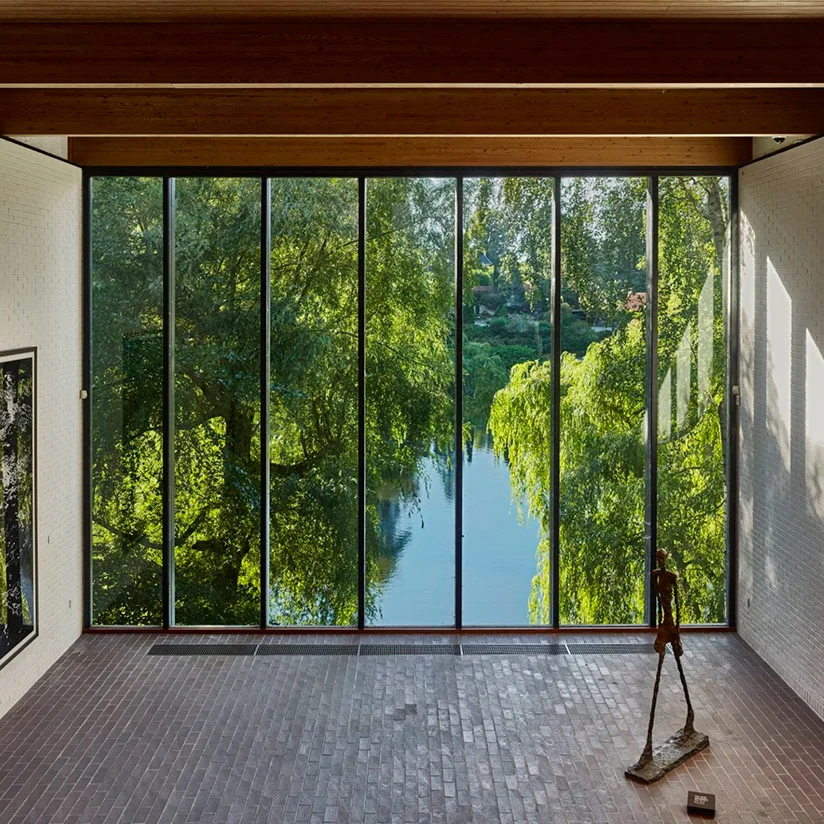
Louisiana Museum of Modern Art: Around 35 kilometres north of Copenhagen, in Humlebæk overlooking the Øresund coast, Louisiana is widely regarded as one of the world’s leading museums of modern art. Rather than separating architecture, landscape and art, the museum brings the three together across its coastal setting, where sculpture and sea views become part of the same experience.
The Circle Bridge: Back in central Copenhagen, Olafur Eliasson’s pedestrian and cycling bridge spans the harbour with five circular platforms inspired by the masts of traditional sailing vessels. Combining public infrastructure with sculpture, it reconnects different parts of the waterfront while keeping the city’s maritime identity in everyday view.
The Bosphorus, Istanbul
The Bosphorus has long served as Istanbul’s commercial and cultural spine. Today, several of Turkey’s leading contemporary art institutions occupy neighbourhoods that descend towards the strait, where former trading districts have evolved into cultural destinations.
Istanbul Modern: Turkey’s first museum dedicated to modern and contemporary art occupies a Renzo Piano designed building directly on the Bosphorus. Since relocating to its waterfront home, the museum has reinforced its longstanding relationship with the strait, pairing an international exhibition programme with one of the city’s most recognisable settings.
Sanatorium: A short walk inland, Sanatorium recently expanded into a four storey building presenting emerging and mid-career Turkish and international artists. Together, the museum and gallery demonstrate how Istanbul’s contemporary art scene continues to gravitate towards the waterway that has shaped the city’s history for centuries.
Tokyo Bay
Tokyo Bay illustrates a different model of cultural development. Rather than emerging around historic commercial streets, Shinagawa’s gallery scene has grown through the adaptive reuse of warehouse and logistics facilities, transforming a working waterfront into a destination for contemporary art.
Terrada Art Complex: Bringing together branches of leading galleries including Scai The Bathhouse, ShugoArts, Tomio Koyama and Taka Ishii, the complex has established Shinagawa as one of Tokyo’s principal gallery hubs.
WHAT Museum: Operated by Warehouse TERRADA nearby, the museum presents exhibitions of contemporary art, architecture and design, many organised around works from private collections. The district demonstrates how infrastructure once devoted to storage can be reimagined as a place for encountering art.
Beyond the Waterfront
Following the water reveals more than a series of art destinations. It reveals how geography continues to influence the cultural life of cities, long after the ships have gone.