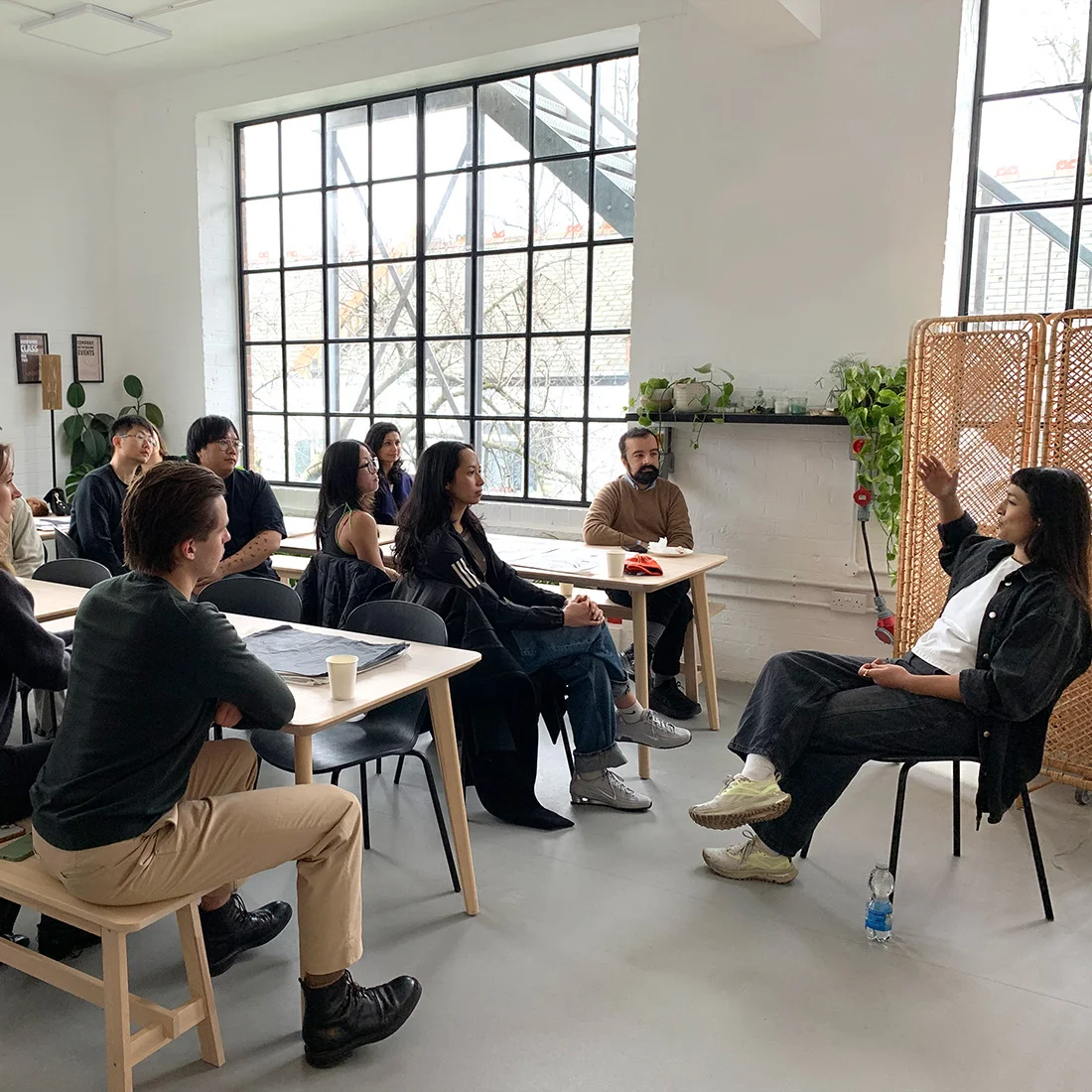
In March 2026, Zarastro Art hosted London-based artist Shumaiya Khan for a Saturday morning studio session in De Beauvoir. Attendees explored contemporary abstraction through a live demonstration, engaging directly with her work. Khan discussed her use of body, landscape, mythology, and spiritual symbolism, sharing materials, techniques, and recurring motifs that reflect transformation, time, and the interplay between physical and metaphysical realms.

Moderator: I’d like to start with a foundational question: what sparked your initial interest in art?
SK: I’ve always painted. As a child, I was very creative, constantly drawing and making things. That intuitive interest continued throughout school. By 18, I excelled in Art, Design, and Literature, and I also write, currently researching for a book that complements my artistic practice.
I went to Leeds College of Art for my foundation year, where we were asked to specialize. At that time, I worried about pursuing art as a career, partly because of warnings about financial instability from people, including one of my tutors. So, I pursued a career in design for sixteen years.
Moderator: What did you learn from that experience?
SK: Messaging—how to communicate about my practice. That skill is still relevant, especially now as I write my book. I was a designer. During COVID, when many were furloughed, I found myself with time alone and realized I wanted to make art again. I started stretching paper, ordering paint, and making works on my living room table. Those early pieces were vibrant and busy, shaped by my design background and fast-paced work.
Over six years, I matured in my practice. I eventually decided to pursue an MA and a career shift, prioritizing happiness and fulfillment over running a design studio, though I still do occasional freelance work. Officially, my art career spans six years, but unofficially, it has been my lifelong pursuit.
Moderator: Can you elaborate on how your work has evolved from your earlier pieces to your current abstract work?
SK: I’ve always leaned toward abstraction. In design, I also illustrated books, which emphasized perfection in line work. In abstraction, the process is more collaborative with my body—exploring movement and energy. Many of the forms I create echo bodies, forests, or natural environments, which led me to explore mythology.
-


Shumaiya Khan Twelve Mirrors… No.3 (2025)
Inquire
Oil, salt and charcoal on card(h) 42 x (w) 29.7 cm
-
Shumaiya Khan Twelve Mirrors… No.5 (2025)
Inquire
Oil, salt and charcoal on card(h) 42 x (w) 29.7 cm
-
Shumaiya Khan Twelve Mirrors… No.9 (2025)
Inquire
Oil, salt and charcoal on card(h) 42 x (w) 29.7 cm


Moderator: And your practice isn’t limited to painting, right?
SK: Correct. My installation work stems from painting. During my MA at City & Guilds, I experimented with how I stored loose canvases, stapling pieces to walls. This incidental process evolved into intentional installation work, where 2D forms grow into 3D forms. I’m currently exploring ceramics, woodwork, and metalwork to expand my painting practice into a three-dimensional space.
For example, my end-of-year show at City & Guilds featured a massive double-sided 3D painting with ribbons, ceramics, and suspended elements, creating an immersive environment. The installations often incorporate mythical references.
Moderator: When you reference mythology, is that linked to your personal spiritual interest, such as Sufism?
SK: My spiritual engagement predates City & Guilds. I am born and raised Muslim, from a Sufi ancestry rooted in Bangladesh, with Yemeni Sufi lineage several generations back. That spiritual knowledge informs my practice naturally. I also explore other spiritual frameworks, including astrology, which I began studying during lockdown.
There’s a link in my work between the metaphysical and the physical body, which is central in Islam and Sufism. The heart is considered the center of knowledge, and the womb is sacred, connecting creation and energy. This perspective intersects with my interest in the chakra system and energy points, reinforcing the connection between physical and spiritual realms in my work.

Moderator: Looking at your large canvases, is there an element of divine love present?
SK: It’s complex. Spirituality isn’t always about love and light; it often involves grappling with reality and inner work. My work engages with these truths, which is why it feels visceral. The physical body is central, including veins, muscles, and blood, reflecting both bodily life and sacred femininity.
I’ve focused on red paintings for about two and a half years, inspired by both the violence in the world and blood as a life-giving substance. This led me to explore women’s roles, ancient mythology, and matriarchal lineage. I’m currently making sculptures of rooms, hip bones, and umbilical cords, exploring physical and metaphysical connections between mother and child. A significant reference is The Great Mother by Erich Neumann, examining ancient female mythologies, including Inanna.
The red color is confrontational, deliberately evoking response. I occasionally use blue or green, representing oxygenated or mineral-like qualities, but my work overall is intense and visceral.
Moderator: Let’s discuss your materials. Why not just use oil paint?
SK: Oil alone works, but I wanted to expand toward a sculptural practice. Charcoal has been part of my practice for sketches and texture, offering a different speed and viscosity. Salt became important during my MA when studying the body; it’s present in everything and provides a visceral texture. Using oil, charcoal, and salt, I create layers that are both metaphorically and physically bodily.
Visually, salt transforms the paint, making it tar-like and intense. Timing is crucial—adding salt at a precise moment affects the work’s texture and energy. Initially, I used acrylic for speed, but now I deliberately slow down to build “body” in the work, both literally and metaphorically.

Moderator: Can you explain your process a little bit?
SK: The sketches are intuitive, following the body’s instinctual energy. I often work vertically on a wall, building downward, like Inanna’s descent into the underworld. Painting on the wall facilitates movement and interaction with the canvas. I sit only for clay or stitching work; most of my canvases are approached standing, engaging physically and conversationally with the surface.
Moderator: How does texture evolve on canvas?
SK: It varies per painting. Initial texture may be applied with salt and oil or thick paint. The early stage is instinctual, followed by molding and adding details. Charcoal may be used at the beginning or end. I always start with preliminary drawings before engaging with the canvas. My forms are inspired by natural structures, bodies, and environments, creating a dialogue between instinct and conscious structure.
Moderator: Could you summarize your focus on materials?
SK: My three main materials are charcoal, oil, and salt. Charcoal offers fast, gestural mark-making; oil builds body and color depth; salt adds texture and a visceral, almost alchemical connection. These elements together form the foundation of my abstract practice, linking physicality, spirituality, and instinct.

Moderator: Can you talk about the choices you made while drawing?
SK: The sketches are instinctual, following the body’s impulses. Positioning on the wall allows for broader gestures. I rarely begin at the bottom; I prefer building downward. Each stroke is about movement and energy. My preliminary sketches capture both subconscious forms and conscious reference to natural structures, the human body, and mythological inspiration.
Moderator: Do you plan color intentionally, or is it instinctual?
SK: Both. Red dominates for its visceral and confrontational quality. Blue or green is occasional, introducing atmospheric or mineral qualities. Color, like form and texture, is chosen for its effect on engagement and emotional response.
Moderator: How do your installations tie into this practice?
SK: Installations extend the principles of painting into three dimensions, creating immersive environments. Sculptural elements mirror painted forms and expand the narrative space. The work is about world-building, where each piece interacts with the viewer, evoking both physical and metaphysical experiences.
Moderator: Do you see your work as primarily personal or universal?
SK: Both. It’s personal, rooted in my spiritual and cultural background, yet universal in exploring human experience, mythology, and the physical body. The work invites viewers into that dialogue, allowing multiple interpretations and emotional responses.
The event transcript has been edited and condensed for clarity.