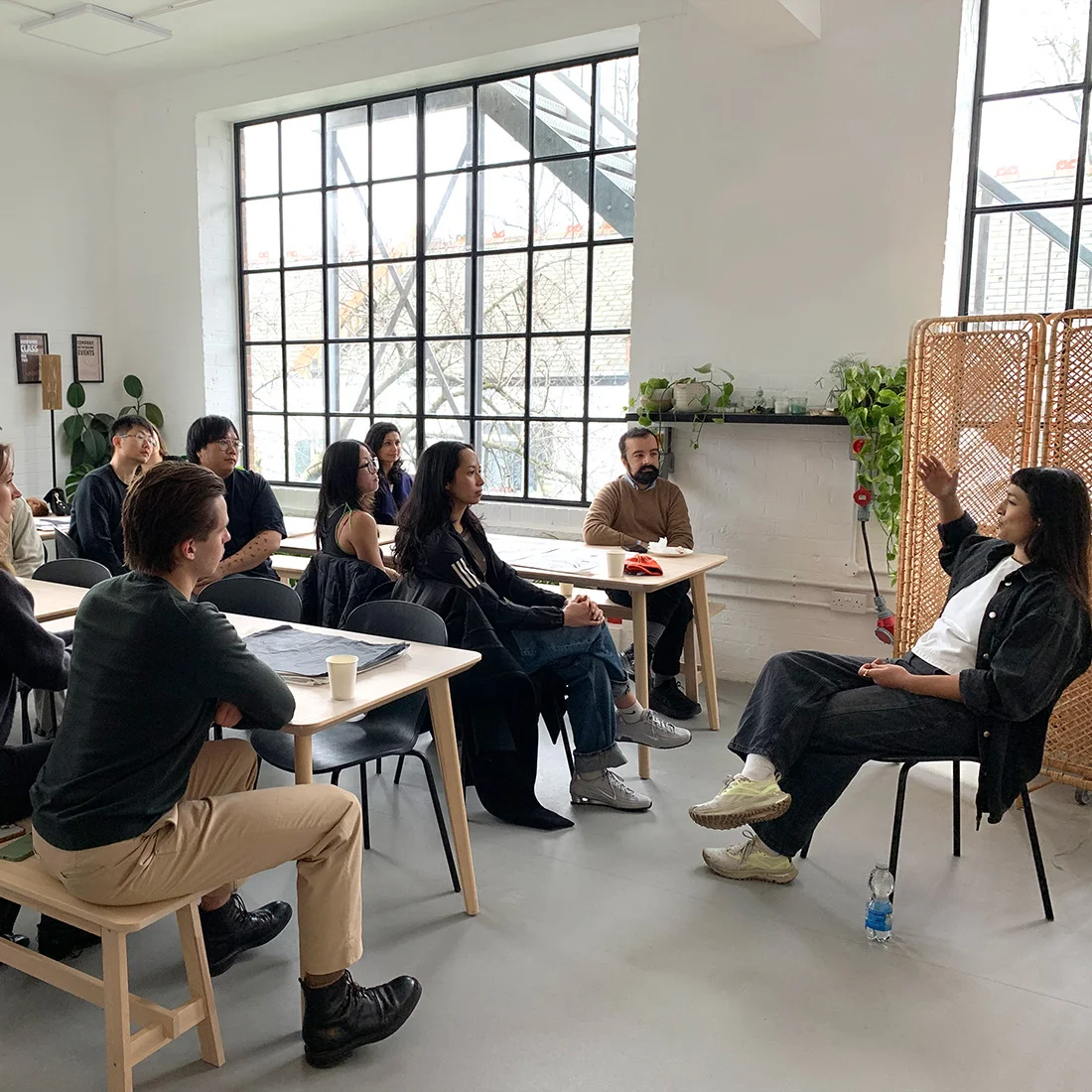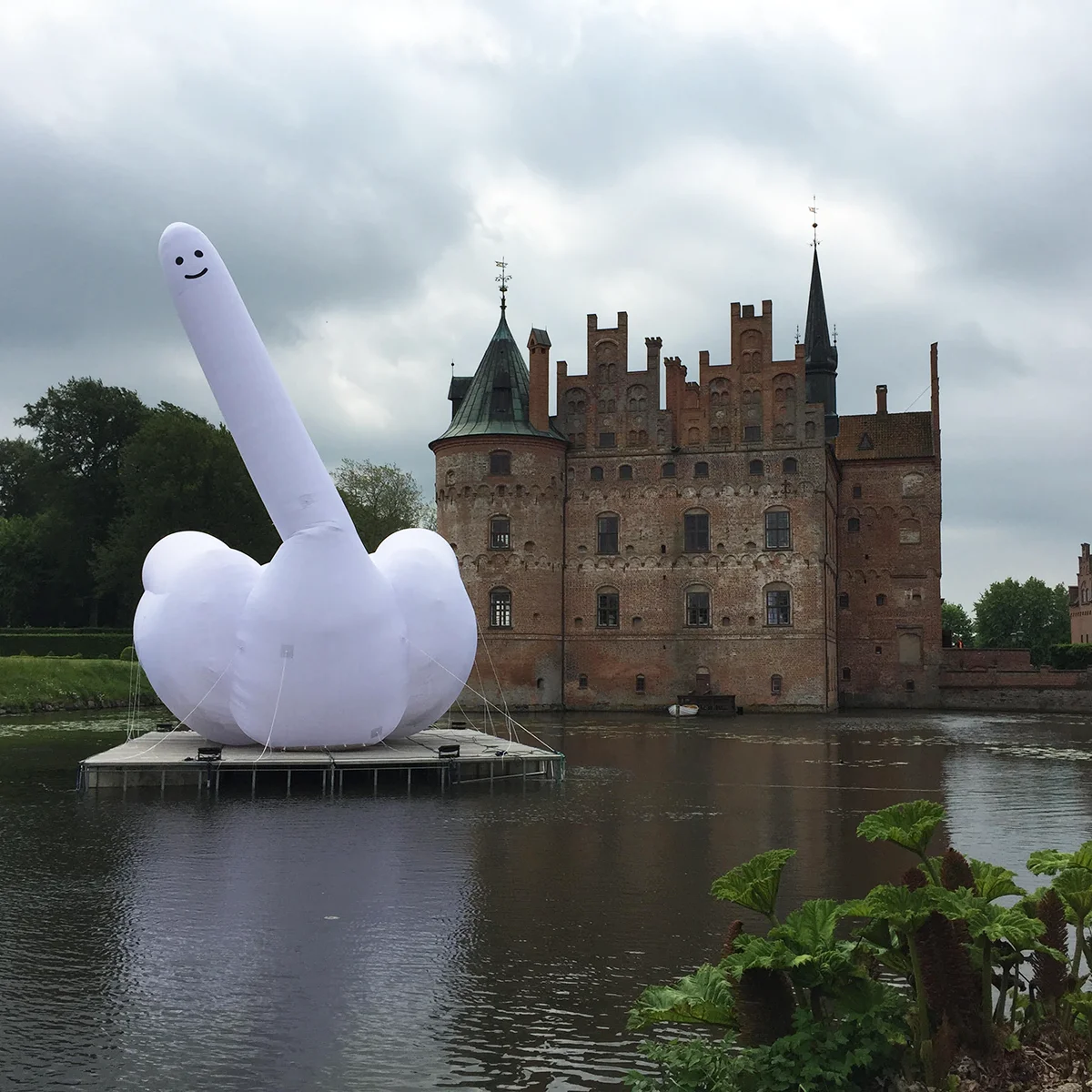
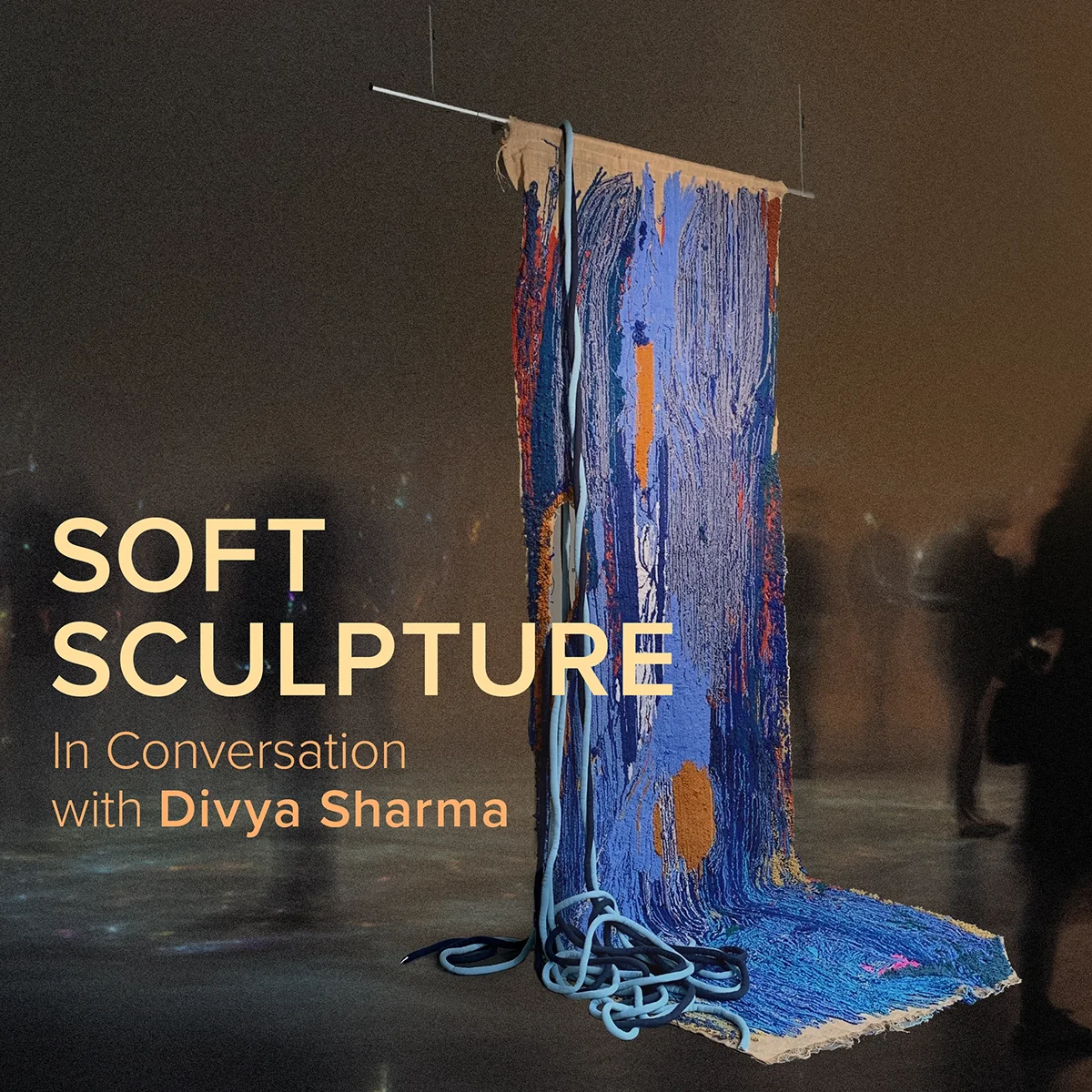
In October 2025, Zarastro Art hosted London-based artist Divya Sharma for an intimate Shoreditch conversation during Frieze Week. Set against the backdrop of large-scale installations at Frieze Sculpture, the event offered a more personal encounter with contemporary sculpture.
Sharma discussed her textile-based practice, transforming fabric into sculptural forms shaped by memory, mythology, and cultural history, while attendees engaged with material samples and explored sculpture through tactility and narrative.
Moderator: How do you think about the term ‘soft sculpture’ in relation to your work?
DS: I feel that the term “soft sculpture” undermines the power and potential of what feminist practices in textiles actually are.
If you look at first wave feminism, intersectional feminism, especially women of colour speaking about their position in society, and then postcolonial artists, you see a long history of using textiles not just as material, but as meaning itself.
Artists are not simply working with textiles, they are using culturally specific textiles to address how colonialism has erased histories and languages. For example, Yinka Shonibare uses Dutch wax resist cloth, which carries its own layered colonial history.
So, “soft sculpture” feels like a misleading term. Yes, it is soft, pliable, accessible, and body-like, but that softness hides its conceptual power. It operates almost like a trickster. It slips into people’s minds quietly and disarmingly. You leave thinking about it, even if you are not fully sure why. It activates something in you.
It is a mode of engagement, not something that keeps the viewer at a distance, which was more typical of traditional, masculine, phallocentric sculpture.

Moderator: Personally, what first drew you to textiles?
DS: I initially avoided textiles completely. I grew up helping my mother, who was very skilled with sewing. She worked every day on her machine and I used to assist her. Because of that, I associated textiles with domestic labour.
Even later, I still saw textiles as aligned with patriarchy, something tied to ideas of women being soft, domestic, and restricted to a certain role. So, I rejected it. Instead, I worked with welding, painting, large metal structures. I was making large cubes that barely fit through doors. I felt 2D work was limiting and overly cerebral. I wanted to make things.
Later, I realised something important. For me, thinking is making. My ideas emerge through process. Some people sketch. I wind thread and ideas start forming.
I joined the Royal College of Art for six months, learned technical skills, but COVID interrupted everything. Many classmates deferred, but I couldn’t. I had to continue. Deadlines and critiques forced action. I started working with a sewing machine during that period, and it just developed naturally. I loved how immediate it was, how versatile it was, and how it did not require technicians.
A few stitches, a bit of paint, and suddenly it became something uncanny, something alive. One thing led to another, then exhibitions and awards followed.
Moderator: You started art education later in life. Looking back, what were the turning points in your practice?
DS: There are many, but two stand out. The first relates to deep time. I am fascinated by antiquity and prehistoric time. I often think about proto-humans and how they saw the world. I would have been an archaeologist if I had chosen differently.
In 2013, I saw an Ice Age sculpture exhibition at the British Museum. There were 60,000-year-old ivory works, incredibly close, almost like looking through a portal in time. It moved me deeply.
It made me realise art predates agriculture. People made art as a primal instinct, not as a luxury. That changed my thinking.
I also believe art school is wasted on the young. Life experience is the real material. Younger students often felt overwhelmed by cost and structure. For me, it was the right time. I brought life with me into the work.
The second turning point was during COVID. I started learning Tamil, my mother tongue, which I never formally learned to read or write.
There is a large Tamil community in London, so I joined a class online. When I began writing the rounded script, I became emotional. It felt like a portal again. It felt ancestral, like a call to reconnect with something deeper. At that point, my practice shifted. It became less purely political and more mystical, more meditative.
Textiles then made sense. Stitching, embroidery, tufting, they all carry that meditative repetition. My tutor even said I speak English with a Tamil accent and Tamil with an English accent. That experience shaped everything.
Language, textiles, and heritage became aligned. COVID was a difficult time globally, but for my practice it was a foundational shift.
Moderator: Let’s go deeper into material. Yarn, hemp, and stitching… Beyond texture and colour, what is happening narratively?
DS: My process is intuitive, but research plays a role. Once I learned Tamil, I gained access to a vast body of poetry and philosophy. Much of it is secular and deeply philosophical, focused on how to live well, how to be a good person, how to exist in society.
Some texts are over 3,000 years old and still relevant. One says compassion is what allows the world to exist. Another says every city is your city and every person is your family. These ideas are astonishingly modern.
There are also myths, including ideas like Lemuria, a lost land said to have been submerged, which some believe erased knowledge and manuscripts. Whether literal or mythological, it becomes raw material for imagination.
I do not work literally. My tapestries are abstract, but they are informed by all of this. I also include political realities. For example, I have worked with themes related to the Tamil genocide in the 2000s, drawing parallels with other contemporary conflicts.
I connected this with Guernica and Picasso, and how art responds to trauma and violence. So the work sits between myth, history, and contemporary politics. It is not forced. It emerges.
Colour also carries history. Traditional dyes like indigo and madder have deep cultural origins. I try to keep the palette restrained, but material history always seeps in.
Eventually I may make my own dyes, but right now I prioritise immediacy and making.
Moderator: Your works feel very present and powerful. Light, gravity, placement, and scale are involved. How do you want audiences to experience them?
DS: That sense of presence comes from experience. As a woman growing up in a traditional society in the 70s and 80s, femininity was often seen as weakness. You had to assert yourself constantly. Later, living in Germany reinforced that need to be visible and taken seriously. So my work is a projection of that. I want it to occupy space, to be larger than life, to demand presence.
Ideally, it should create awe and draw people in through texture, colour, and scale. I also want people to move around the work. It is not just front-facing. The back is equally important. It is not precious.
I am influenced by artists like Magdalena Abakanowicz and Phyllida Barlow, where space, gravity, and material all become active participants.
Moderator: How do you choose the symbols, stories, and references?
DS: Most of my works are created in response to commissions or exhibition themes. I respond to curatorial prompts, then bring in my own research, especially from Tamil literature, myth, and political history.
For example, for a post-COVID show about care, I explored care as something undervalued until crisis made it visible. For a show at Somerset House, I referenced Tamil Nadu architecture and colour, connecting it to colonial histories of cotton and textiles.
That work became a kind of blueprint of a fantasy home, reflecting nomadic identity and shifting ideas of belonging. Home, for me, is not fixed. It is something you construct through movement, culture, and adaptation.
It always depends on context, but my Tamil heritage is always present. It is a way of acknowledging where I come from while also reimagining it.
—
The transcript has been edited and condensed for clarity.