Sonia Boyce’s Demonstrate at the Queens Museum brings together film, photography, sound, and installation to explore collaboration, participation, and collective making, treating these not as subject matter but as a working method through which meaning is produced in real time within shared space.
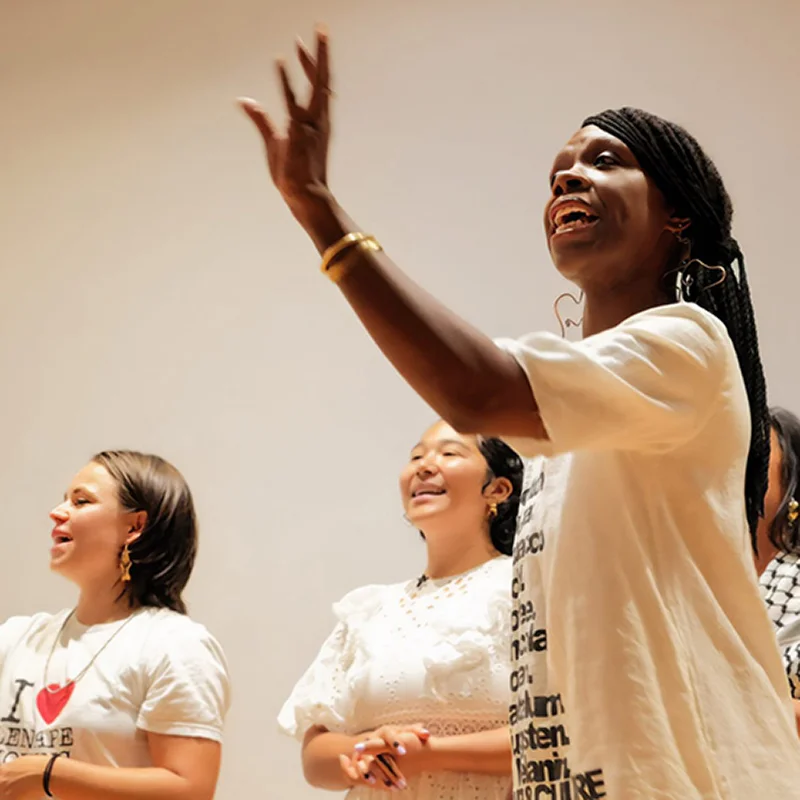
Developed over two days of filming at the Queens Museum in October 2025, the project continues Boyce’s approach to art as social practice. Rather than directing participants, she encourages spontaneity, allowing people to negotiate shared space through making, singing, speaking, and movement. Working with local organisations, artists, educators, New Yorkers, and the Resistance Revival Chorus, she records encounters that form the basis of the exhibition.
The installation spans six films across seven screens, alongside photographs and kaleidoscopic wallpaper prints derived from the footage. Instead of presenting linear documentation, Boyce reworks material through layered imagery, mirrored patterns, text, and sound. The result is an immersive environment shaped by improvised and self-narrated experiences, moving between celebration, testimony, commemoration, ritual, and play.
The project is rooted in the museum’s existing communities rather than extending outward. Activities include workshops in artmaking and movement, the installation of a Día de Muertos community ofrenda, and performances by participating artists. It culminates in a procession led by the Resistance Revival Chorus through the museum and into the Panorama of the City of New York. Their call and response singing, adapted to include Spanish speaking visitors, becomes a shared act of participation and care, where sound functions as connection and activation.
The exhibition traces the evolution of Boyce’s practice since the 1990s. Emerging in the early 1980s within the Black British Arts Movement, she produced figurative pastel drawings and photocollages addressing race and gender in Britain. Her practice later shifted toward collaboration, improvisation, sound, movement, and shared authorship. This transition reflects a redefinition of artistic agency, shaped by uncertainty and participant-led processes.
Boyce’s career has been marked by sustained institutional recognition. She became the first Black woman elected to the Royal Academy of Arts in 2016 and represented Britain at the 2022 Venice Biennale with FEELING HER WAY, which received the Golden Lion for Best National Participation. She is Professor of Black Art and Design at the University of the Arts London, an Honorary Fellow of the American Academy of Arts and Sciences, and was made a Dame in 2024.
Demonstrate reframes the museum as a site of active cultural production rather than passive observation. Making together becomes a political act, where collective imagination shapes shared worlds.