Kyotographie: Kawada Kikuji x Iwane Ai unites two generations of Japanese photography in their first joint presentation in the UK. Through distinct yet complementary practices, Kawada and Iwane examine the enduring legacies of war, migration, nature, and identity with remarkable sensitivity and visual imagination.
Organized in partnership with the Kyotographie International Photography Festival, the exhibition marks the first photography exhibition at Japan House London. While Kawada Kikuji and Iwane Ai belong to different generations, both have participated in the Kyoto based festival and approach photography as a medium that extends beyond documentation. Their works favour atmosphere, symbolism, and emotional resonance over literal description.
Now 93, Kawada is widely regarded as one of Japan’s most influential photographers, having remained at the forefront of the medium for eight decades. At the centre of the exhibition is Chizu (The Map), his landmark 1965 photobook examining the enduring scars of postwar Japan.
Rather than depicting the devastation of Hiroshima directly, Kawada turned to fragments, traces, and symbolic objects. Stains left on the walls of the Genbaku Dome, together with remnants of American consumer culture found in the city’s aftermath, become meditations on destruction and survival. His photographs suggest that some experiences resist straightforward representation, inviting reflection through ambiguity rather than explanation.
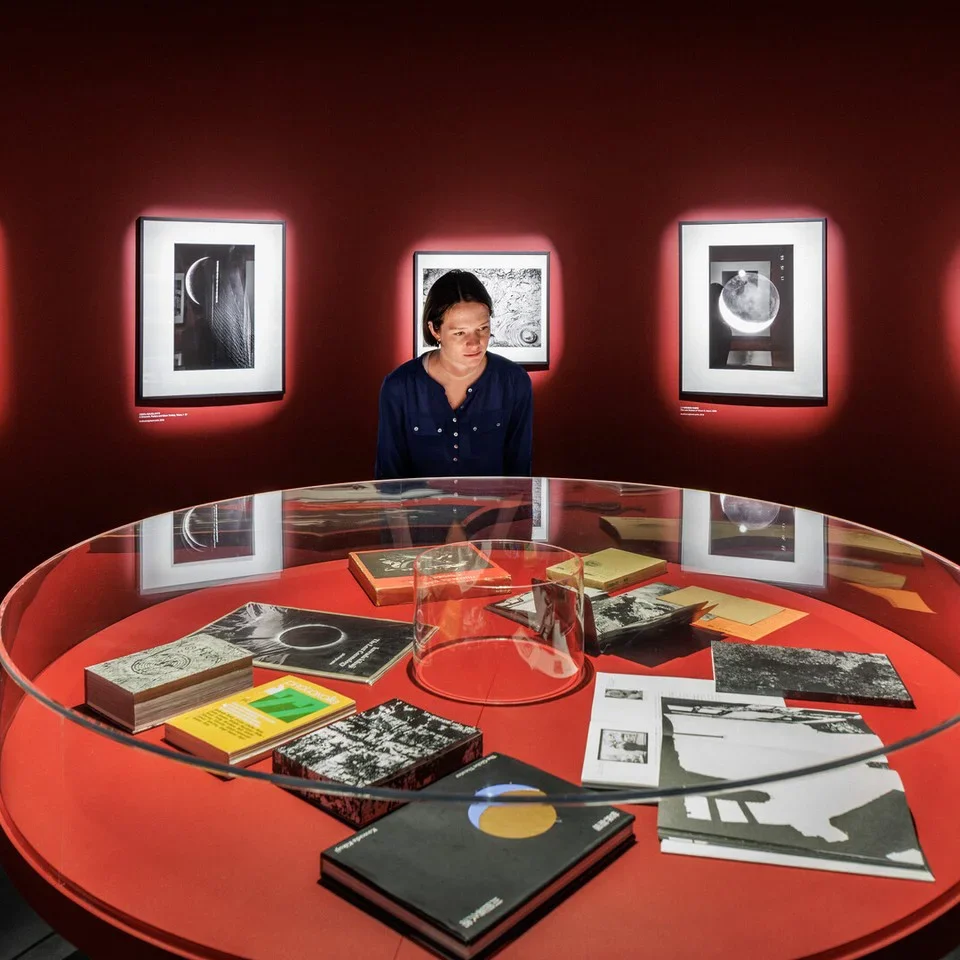
The exhibition also demonstrates the remarkable evolution of Kawada’s practice. The Last Cosmology reflects his enduring fascination with celestial phenomena, while recent digital works, regularly shared through social media, continue his exploration of fire, water, horizons, smoke, and shifting light. Together they reveal an artist whose curiosity has remained undiminished, embracing new technologies while continuing to investigate the limits of perception.
In her first major UK exhibition, Iwane presents two acclaimed series that examine community, migration, and resilience. Kīpuka focuses on the lives of Japanese immigrants in Hawaii, where cultural traditions have been sustained across generations. Inspired by historical panoramic funeral photographs and the Hawaiian concept of a fertile oasis surrounded by hardened lava, the series brings together Bon dances, archival imagery, and volcanic landscapes to connect Hawaii and Japan through shared experiences of displacement and renewal.
Her series, A New River, turns to Japan’s northeastern Tōhoku region during the COVID-19 pandemic. Photographed at night, its luminous cherry blossoms are inhabited by figures drawn from Japanese folklore, transforming one of the country’s most familiar motifs into something quietly uncanny. Beauty and melancholy coexist, creating images that reflect both personal grief and a broader sense of impermanence.
Though shaped by different generations and perspectives, both artists use photography to uncover what persists, across landscapes, communities, and time.