Ai Weiwei’s Button Up! examines the intertwined histories of China and Britain through an ambitious exhibition of sculpture, installation and new commissions. Set within a former industrial hall in Manchester, it explores empire, industrialisation, migration and censorship, revealing how history shapes today’s political and humanitarian realities.
Button Up! is Ai Weiwei’s most expansive exhibition in northern England to date. Conceived as a total environment, it brings together newly commissioned works with large scale installations shown in the UK for the first time.
Drawing inspiration from Manchester’s central role in the Industrial Revolution, the exhibition traces two centuries of Chinese and British relations, revealing how trade, imperial expansion and systems of exploitation continue to shape the contemporary world. Porcelain, cotton, glass, bronze, buttons and toy bricks become vehicles for exploring globalisation, production and consumption.
The exhibition’s title carries both historical and personal significance. It refers to the millions of salvaged buttons that form Eight Nation Alliance Flags, a new commission produced for the Warehouse. The eight monumental flags recreate the banners of the military alliance that invaded Qing dynasty China at the turn of the twentieth century, linking colonial violence with Manchester’s industrial heritage.
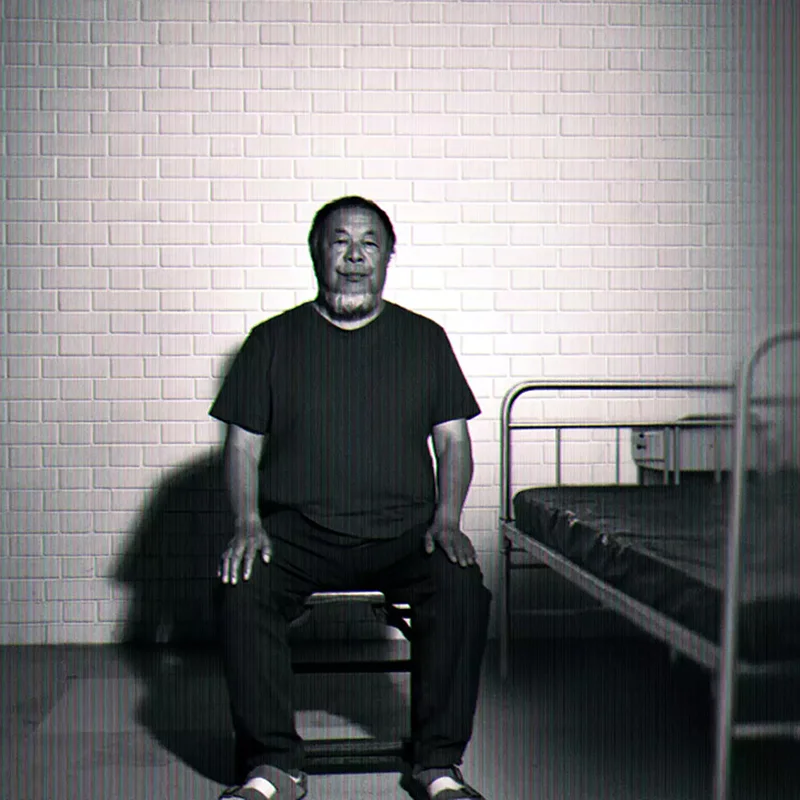
At the same time, Button Up! alludes to Ai’s own experiences of censorship and state control, reflecting his longstanding belief that even seemingly ordinary actions can carry political meaning.
New commissions appear alongside some of Ai Weiwei’s most ambitious installations. History of Bombs, recreated entirely from toy bricks, presents a vast survey of weapons of mass destruction, linking warfare to the human consequences explored throughout the exhibition.
Nearby, Law of the Journey (2017), the artist’s largest work to date, transforms an inflatable migrant boat filled with hundreds of human figures into a powerful monument to the global refugee crisis. Together, the two works connect military conflict, migration and humanitarian injustice within a single narrative.
Historical memory takes physical form through Wang Family Ancestral Hall (2015), a Ming dynasty temple painstakingly reassembled from 1,500 original wooden components. Presented as both architecture and cultural artefact, it reflects on preservation, identity and the fragility of historical narratives.
Elsewhere, La Commedia Umana (2017-21), a vast black Murano glass chandelier composed of more than 2,000 pieces, and Circle of Animals/Zodiac Heads (2010), Ai’s reinterpretation of the Chinese zodiac, extend the exhibition’s dialogue between tradition, power and contemporary society.
Throughout Button Up!, Ai Weiwei intertwines personal experience with global history. His reflections on exile, detention and censorship are woven into broader examinations of empire, conflict and migration. The exhibition argues that today’s crises cannot be separated from the histories that produced them.