Phyllida Barlow: Disruptor at Wolterton brings together more than seventy works spanning five decades of the artist’s career. Installed throughout the Grade I-listed Norfolk estate, the exhibition places Barlow’s unruly sculptures in direct dialogue with historic architecture, creating a powerful encounter between permanence and disruption.
Curated by Simon Oldfield with guest curator Clare Lilley, Phyllida Barlow: Disruptor takes place across three rooms at Wolterton and extends into the surrounding landscape. At a moment when many historic estates are turning to contemporary art to reframe their relevance, Wolterton takes a more forceful approach. Rather than inserting artworks into heritage space, it allows Barlow’s practice to actively destabilise it.
The exhibition makes its position clear from the outset. The large-scale installation untitled: stackedchairs (2014) greets visitors with an accumulation of red plywood chairs, piled into an unstable mass. It immediately disrupts the order of the stately interior. The work captures Barlow’s long-standing focus on precarious balance and ordinary materials, where structures feel both constructed and on the verge of collapse. Sculpture is positioned here as interruption, not ornament.
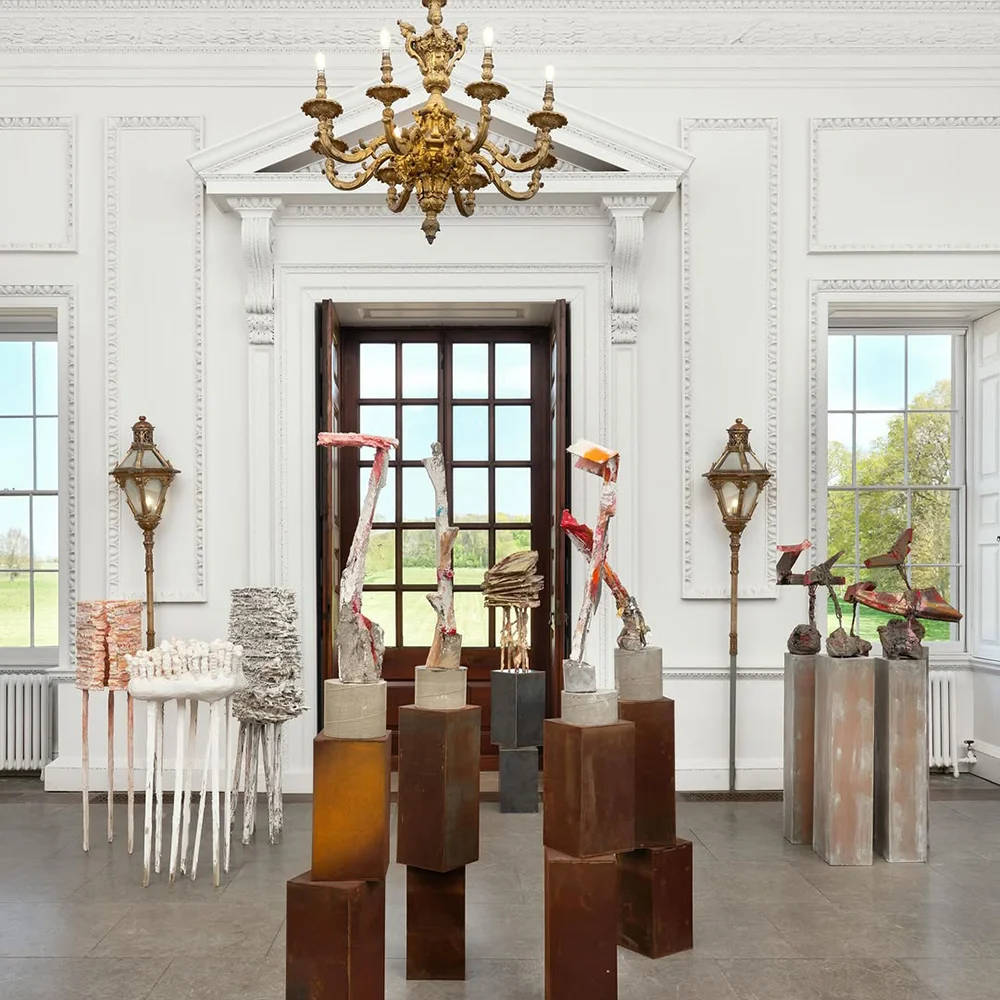
Across the estate, Barlow’s material language remains deliberately exposed. Works are built from plywood, scrim, plaster, cement, fabric, tape, cardboard, foam, plastic and rope. Nothing is hidden. Joins are visible, surfaces remain rough, and adjustments are left unresolved. Set against Wolterton’s marble, stone and decorative plasterwork, this openness becomes confrontational. The house asserts continuity and inherited authority, while the works insist on labour, contingency and process.
A dedicated room gathers works from early experiments to later wall-based sculptures. Among them is Loaf, an early piece made from glass and paper coated in latex. Familiar in form yet materially disorienting, it distorts recognition through surface and substance. Nearby, wall works built from plaster, cement and scrim push outward into space, while knobbly tower-like forms populate the room like a fractured landscape, loosely echoing the surrounding estate without settling into representation.
The Portrait Gallery brings together drawings from the 1970s to the early 2010s, many shown here for the first time. Installed salon-style, they offer a concentrated view of Barlow’s thinking through repeated studies of stacks, barriers and provisional structures. Their context intensifies the dialogue with the building. Historic portraits have been removed, exposing bare walls marked with builders’ measurements and notes. Barlow’s drawings sit alongside these traces, producing an unintended but precise overlap of artistic and architectural labour.
The exhibition closes outdoors with PRANK: jinx (2022/23), one of Barlow’s final major works. Rusted steel studio tables are stacked into a precarious structure, topped with her recurring “rabbit ears” motif. Set against the formal landscape of Wolterton, the work refuses resolution or monumentality. It holds its imbalance openly, extending the exhibition’s central logic into the landscape itself, where stability is tested rather than confirmed.
Born in 1944, Phyllida Barlow reshaped contemporary British sculpture by challenging ideas of permanence, authority and finish. At Wolterton, her work stands in direct dialogue with a house built to embody those very ideals.