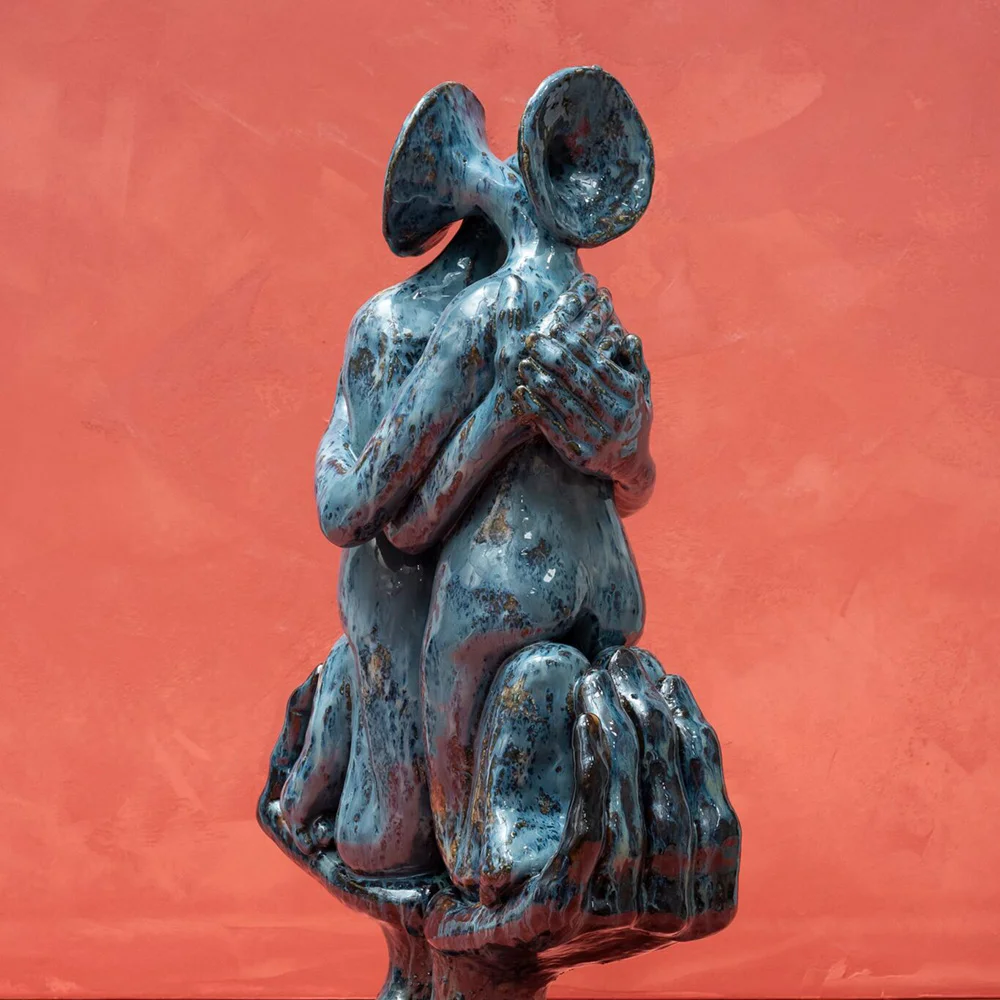
Woody De Othello returns to Miami with a museum exhibition that traces the links between body, material, ancestry, and spirit. coming forth by day, on view at Pérez Art Museum Miami, brings together new ceramics, wooden sculptures, tiled wall works, and a monumental bronze piece.
Raised in North Miami Beach in a Haitian immigrant household, Othello grew up within Catholic ritual and the overlapping Caribbean and Latin American cultures that shape the city. Even after moving to Oakland for graduate school and establishing his career, Miami remains the place where his personal and artistic histories align.
The exhibition title draws from Muata Ashby’s reinterpretation of the Egyptian Book of the Dead. For Othello, the notion of arriving each day renewed offers a way to think beyond colonial framings of Black existence. That position informs his anthropomorphic sculptures. Clocks, kettles, and mirrors slump and lean, glazed in oily, uneven surfaces that reject polish and behave like skin. They read as bodies without abandoning their objecthood.
Recent works grow out of sustained research into precolonial and diasporic African traditions, including Nkisi power figures, Dogon ritual forms, and Southern face jugs made by enslaved potters. These references frame objects as carriers of memory and force. His turn toward wood follows the same logic, asserting carving as a primary ritual practice rather than a subordinate craft.
For this exhibition, Othello extends the work into sound and scent. With Oakland-based musician Cheflee, glaze colors and wood tones become an ambient score tied to specific frequencies. A vetiver-based scent developed with herbologist Martin A. Tsang circulates through the galleries, referencing Haiti. Together, these elements deepen the sculptural atmosphere.
At the center of the exhibition stands a large wooden pyramid adapted from a diagram in Eugene Fersen’s The Science of Being. Reworked from a model of balance into a walk-through structure, it houses ceramic objects and pockets of incense. The form invites pause and recalibration, holding pressure rather than resolving it.
Throughout the exhibition, African cosmologies surface subtly, particularly the understanding of the head as the seat of consciousness. Othello’s sculptures operate through sensation rather than instruction, privileging felt knowledge over explanation. coming forth by day binds material experimentation to heritage and inward attention. The works breathe, lean, and listen, asking viewers to slow down and consider how objects hold history and how bodies carry spirit.
Miami now occupies a global art circuit shaped by fairs and institutions. The momentum is undeniable, but so is the risk of erasure. Growth only matters if communities remain visible within it. Art has to stay accessible rather than ornamental, because it reshapes how people think and how they move through the world.