Divya Sharma

Shape of Identity

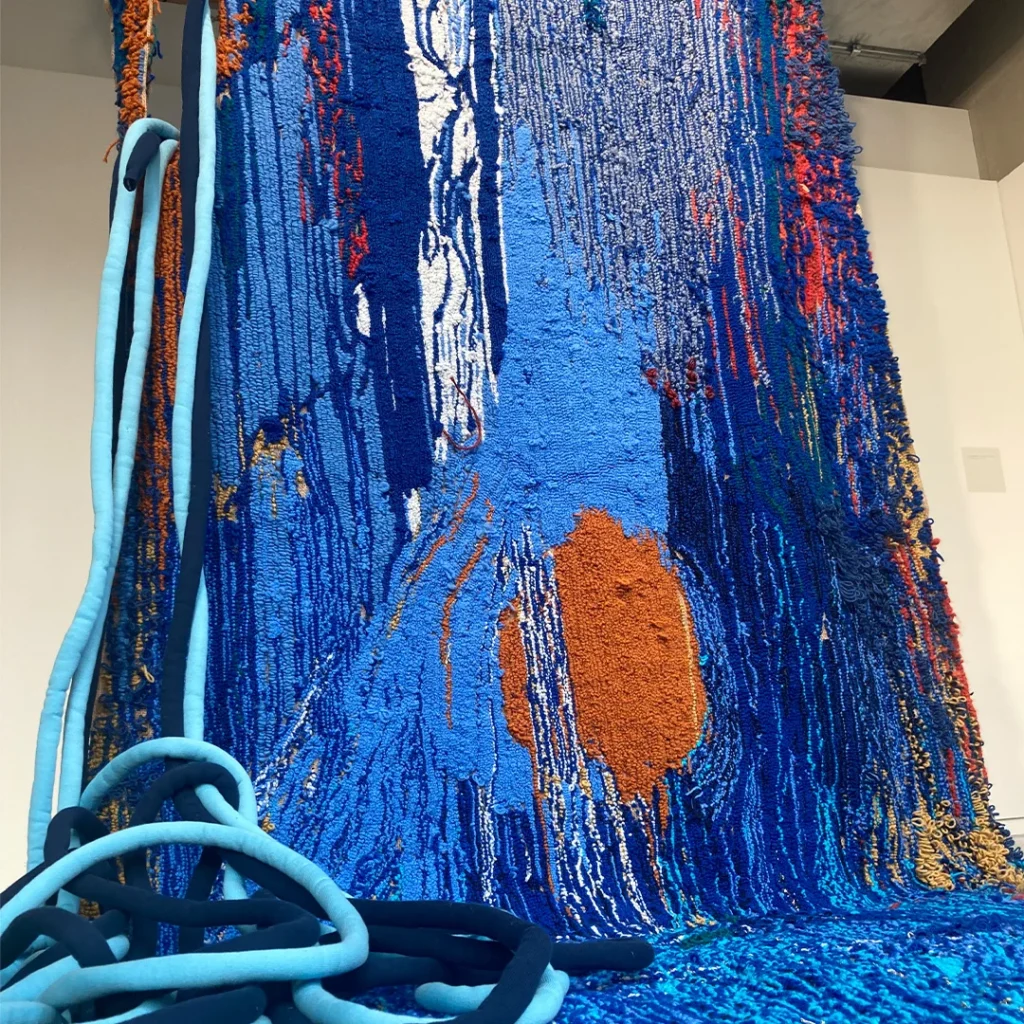
Divya Sharma’s Shape of Identity is an early work that begins to set out themes she continues to develop in her practice, while still functioning as a resolved piece in its own right. Created for the exhibition Home Ground Helps in Karachi, Pakistan, the tufted tapestry engages directly with borders, belonging, and the unstable conditions through which identity is formed.

The surface is built from layered blues that shift between dense and open fields. From a distance, it recalls cartographic views of divided land and unstable shorelines. Up close, the tufted surface reads as terrain, rising and falling like physical ground. Mapping is not represented but made material, turning abstract borders into something that can be felt.

Divya Sharma Shape of Identity (2022), acrylic yarn tufted on hemp, 300 x 120 cm

“For me, thinking is making. My ideas emerge through process. Some people sketch. I wind thread and ideas start forming.”

 
– Divya Sharma

Blue operates as a structural contradiction. It suggests containment through mapped waters, edges, and systems of division, while also resisting definition through its associations with sky and sea. The work holds this tension without resolution, framing borders as imposed systems placed onto something fundamentally fluid.

These tensions extend into questions of collective memory, ancestry, and the constructed narratives that shape diasporic identity. Rather than being illustrated, they are embedded in the work’s structure, where identity emerges through fragments of memory, culture, and displacement. Home is not fixed to a single place but formed across overlapping geographies and unstable points of return.

In Sharma’s practice, weaving and tufting function as methods of building meaning through labour, repetition, and layering. Place-making becomes an ongoing process in which history is continuously reworked rather than settled.

Shape of Identity resists closure, instead asking what identity becomes when it is continuously formed through material, memory, and perception, and what remains when no single origin can hold it together.

“My work reflects on my journey as an immigrant, splicing together autobiographical and fictional narratives that re-imagine what it means to belong. Faced with histories that have been silenced by imperial regimes, I use my work to envisage new stories.”

 
– Divya Sharma

About the Artist

Divya Sharma is a London-based Indian-British multidisciplinary artist and alumna of the Royal College of Art (MA Sculpture) and the University of the Arts London (BA Painting). Working across textiles, thread, video, and site-specific installation, her practice focuses on place-making through labour-intensive processes.

Raised in India in a home where fabric functioned as both material and language, her relationship to textiles is shaped by lived experience and her mother’s fabric sculptures. Drawing on myth, memory, and the cultural landscape of Tamil, she uses tufting and tapestry to explore fragmented histories, imagined geographies, and displaced narratives. Through material density and scale, she constructs environments where memory, body, and perception intersect.

Focus

Explore a single cutting-edge work, uncover its narrative, and experience contemporary art more profoundly

Subscribe

Join our mailing list to receive our weekly newsletter, exhibition updates, and special offers.

Art Basel 2026: Visibility, Presence, Scale

Bringing together 290 galleries from 43 countries, Art Basel 2026 extends from historical anchors through contemporary practices into increasingly constructed, large-scale environments. The fair still functions as a central meeting point for the market, but its relevance now depends less on discovery and more on how effectively it concentrates attention across multiple, tightly managed spaces. For more than half a

Read More »

Medina Triennial 2026: All That Sustains Us

The Medina Triennial unfolds along the Erie Canal in Western New York as a village-wide exhibition titled All That Sustains Us. It brings together 39 artists and collectives in a free, walkable programme across post-industrial and public sites, linking contemporary art with ecology, labour, and infrastructure. Co-curated by Kari Conte and Karin Laansoo, the Triennial positions Medina as an active

Read More »

Second Lives and City Lit Partnership Announced at Burgh House Breakfast

Second Lives, an exhibition platform celebrating artists who have developed their practice alongside other careers, entered a new chapter with a gathering at Burgh House. Hosted by founder Paula Lent, the event brought together artists, curators, and leaders to celebrate a partnership with City Lit. The breakfast brought together a diverse community of creatives, curators and cultural leaders to reflect

Read More »
David Hockney by Catherine Opie | National Portrait Gallery | Zarastro Art

David Hockney (1937–2026): Pools, Landscapes, Perspective

David Hockney, pioneering British artist, has died aged 88, closing a six-decade career that reshaped painting, photography, and stage design. From California swimming pools to Yorkshire landscapes, he redefined perspective, embraced technology, and created instantly recognisable works that fused intimacy, colour, and innovation across media. He died on 11 June 2026, at home, according to his representatives. They described a

Read More »
Oscar Santillán | Copperfield | London Gallery Weekend

London Gallery Weekend 2026: How a Dispersed Scene Becomes One

London possesses one of the world’s most extensive and geographically dispersed gallery ecosystems. London Gallery Weekend 2026 brings together more than 120 galleries, over 80 public events, a growing network of institutional partnerships and a citywide programme spanning multiple neighbourhoods. Now in its sixth edition, the initiative has become a key fixture in the international art calendar, creating a framework

Read More »
Ogawa Shinji | Art Osaka 2026

Art Osaka 2026: Contemporary Art Through the Lens of Kansai

Art Osaka 2026 enters a new phase with an expanded two venue format spanning Grand Green and Creative Center. Bringing together more than 60 galleries from Japan and across Asia, the fair connects commercial presentations, large scale installations, and regional histories through a distinctly Kansai perspective. Founded in 2002, Art Osaka is among Japan’s longest-running contemporary art fairs. Organised by

Read More »

Contact us

Fill in the form below to inquire about this artwork.

Join our newsletter and grab your free copy of Best Exhibitions Around the World in 2026.

Plus, continue to stay updated on the contemporary art world through a weekly digest of headlines and our own new articles!