

Humor holds a precarious place in contemporary art: it can deliver complex messages, create contrast, or even challenge tradition. Within a long legacy that has treated art as serious and austere, humor becomes an act of protest, a perspective that dismantles the notion of art as fixed and definitive.
One of the most prominent contemporary artists to use humor as a central element of his work is David Shrigley, a painter, sculptor, and animator based in Brighton and Devon, UK. Shrigley’s work fuses brutal simplicity with biting humor, exposing the hidden absurdities of daily life with razor-sharp wit.
Background and Rise
Shrigley was born in Macclesfield, UK in 1968. He took an Art and Design Foundation course at Leicester Polytechnic, now De Montfort University. In 1991, he graduated from the Glasgow School of Art.
Although he is now acknowledged by the art world as an influential figure, this was not always the case. He did not become more well-known until the 2010s. He was recognized with an OBE in the 2020 New Year Honours.
Shrigley's Artistic DNA
Shrigley was influenced by major 20th-century movements, including Surrealism, Dada, and Pop Art. Dada is especially evident in his ironic defiance of convention. His work also resonates with Outsider Art, reflected in his deliberately amateurish style and use of unpolished materials.
Embracing deadpan absurdity, he satirizes everyday interactions with childlike curiosity and macabre twists that expose human fragility. Rooted in drawing, his practice features rough line work and flawed typography that create intimacy while delivering incisive commentary. He extends this approach into painting and sculpture, often incorporating unconventional materials.
Everyday Wit
One of the most appealing aspects of David Shrigley’s work is its accessibility. His prints and posters, pairing witty text with simple illustrations, are widely collected and bring his ideas to a broad audience.
Addressing themes like consumerism, mental health, and the search for meaning, his art resonates with contemporary life. Through satire, he challenges artistic elitism and traditional notions of merit, using a deliberately crude style and unconventional materials to prompt us to reconsider what qualifies as art.
Major Shows and Projects
Presented in Copenhagen at Galleri Nicolai Wallner, in People Reveal Themselves Slowly, Shrigley layers fragments of his own work into his sketching style in an unstructured yet personal way. Bold brushstrokes in pink, blue, yellow, and green dominate the paper, drawing viewers in and allowing each piece to be experienced individually.
Shrigley blends a wide range of subjects with intimacy, moving from death, politics, and existential themes to everyday activities like spilling drinks or climbing stairs. The philosophy of elevating the ordinary and the mundane is apparent in this show, where everyday objects are placed beside animals and parts of the natural world.
Shrigley’s ceramics featured prominently in the Arms Fayre exhibition at Stephen Friedman Gallery in 2012, highlighted by a series titled Bombs. These sculptures capture the iconic shape of a missile—an elongated oval on four supporting feet—while black glazed surfaces conceal a fragile ceramic core, contrasting the object’s usual association with destruction. Their appeal lies in the simplicity of form: seductive yet unsettling, instantly recognizable without exact replication. Echoing playful Surrealism, Shrigley references René Magritte while nodding to the post-war humor of Spike Milligan.
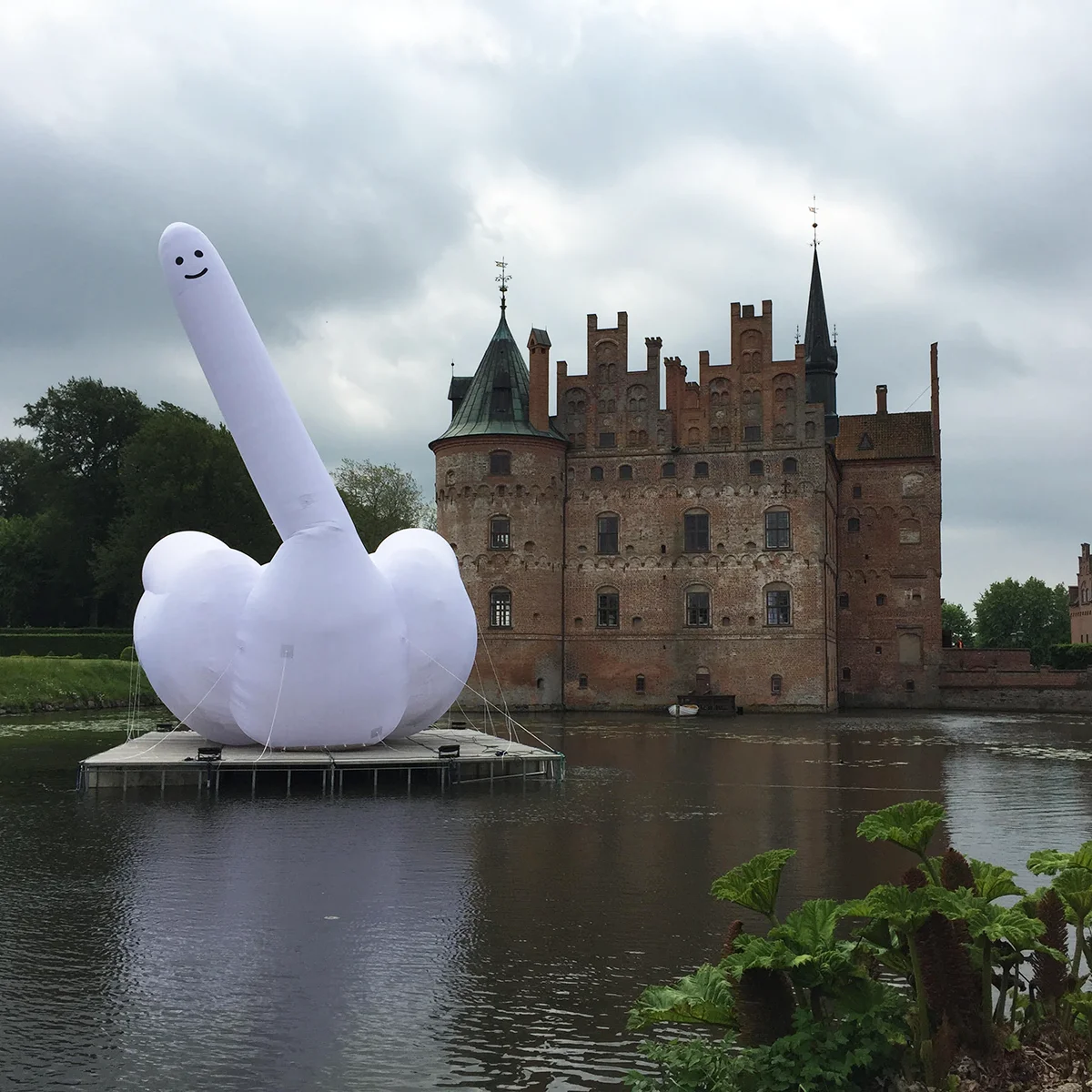
Giant Inflatable Swan Things, created exclusively for Spiritmuseum in Sweden, was on display from September 2018 to March 2019. The piece bends reality, upending physics and twisting the familiar into something absurd.
Given full creative freedom, he reimagined the swans with straight, upright necks and cartoon-like grinning faces instead of beaks. The gallery featured a dozen inflatables cycling through twelve-minute sequences of inflation and deflation.
Humor in Form
Shrigley works across different mediums like painting, ceramics, and sculpture, while also utilizing less common materials such as neon and tennis balls. This ends up creating a diverse and unique collection of artworks.
The I Hate Humans series departs from his earlier focus on absurdist humor and wordplay, reflecting his ongoing interest in the human-animal relationship. Since 2019, he has produced prints, sculptures, and drawings of creatures such as polar bears, seals, and badgers.
Really Good stands seven meters high and depicts a bronze hand giving a thumbs up, reaching ten meters including its humorously extended thumb. The sculpture is finished with the same material as the other monuments in the famous Trafalgar Square: a dark patina. This work is a satirical critique of the status quo, and exemplifies the cognizant irony that is present in much of Shrigley’s art, calling for reflection on humor’s role in navigating challenges.
Shrigley’s The Tennis Ball Exchange is a shift towards interactivity with the public. Visitors bring old balls to trade for new ones, with rows of yellow spheres gradually transforming into distorted shapes, symbolizing the absurdity and delight of exchange.
Clock resembles public digital clocks but is out of focus despite showing the correct time, creating both amusement and a sense of disconnection from societal norms. Inspired by Shrigley’s deteriorating vision, it speaks to those who feel excluded from convention.
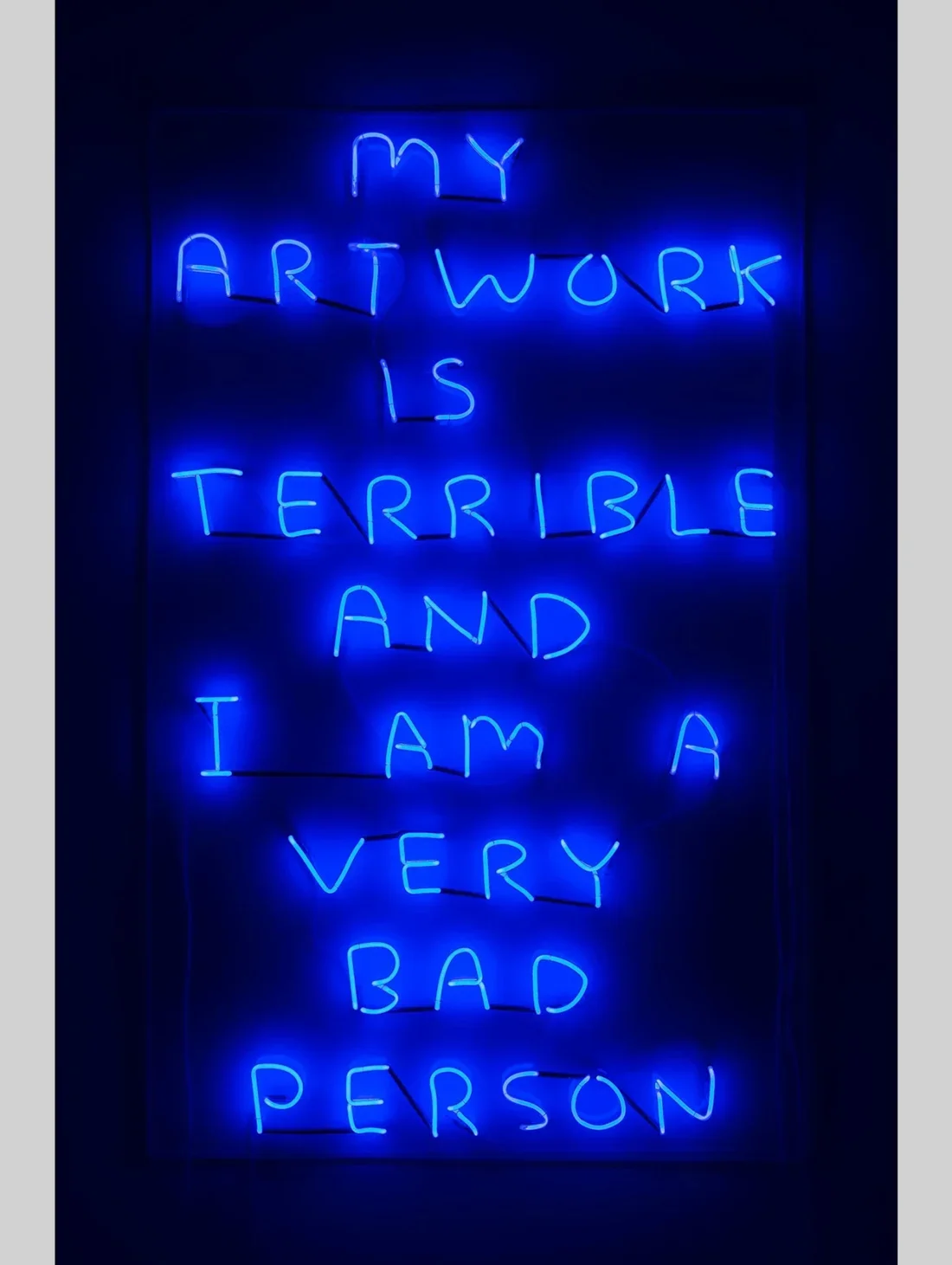
Finally, the neon sign My Artwork confronts artists’ insecurities and public criticism. Its lines—“My artwork is terrible and I am a very bad person”—mock and preempt critics, highlighting the absurdity and humor central to his practice.
Art for Everyone
David Shrigley’s work engages both art lovers and the general public. Beyond museums and galleries, his drawings appear in books, music videos, and everyday objects like tea towels and mugs.
In essence, Shrigley sparks conversation through humor and absurdity, prompting reflection on human existence while highlighting the value of simplicity in a world that often takes itself too seriously.