At this year’s Venice Biennale, the British Pavilion stands out through intimacy rather than scale. Lubaina Himid transforms the historic space into a layered environment shaped by sound and memory, creating one of the Biennale’s most widely discussed presentations without relying on visual excess.
Titled Predicting History: Testing Translation, the presentation unfolds through painting, sound, language, and spatial rhythm. Rather than treating history as fixed, Himid approaches it as something shaped by migration, memory, labor, and lived experience.
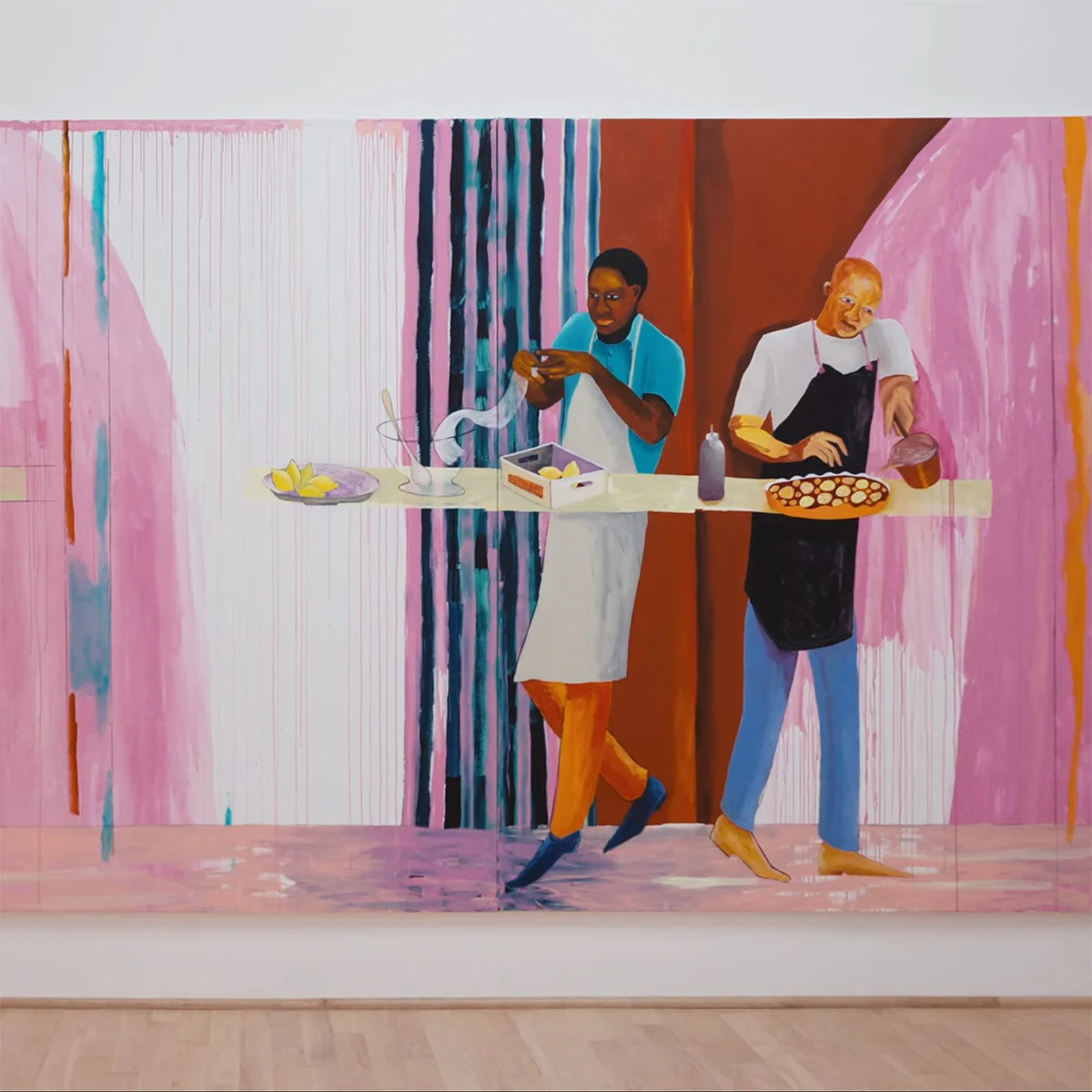
Across the pavilion, architects, gardeners, cooks, sailors, and tailors move through theatrical yet unsettled scenes, figures attempting to construct belonging within unfamiliar environments. The exhibition feels less concerned with delivering statements than with exploring the instability of home itself.
Sound plays a central role throughout the pavilion. In collaboration with Magda Stawarska, Himid introduces an ambient composition of creaking rigging, distant birds, buzzing insects, and drifting acoustic fragments that move between rooms.
The soundscape initially recalls an idyllic summer day before gradually becoming stranger and more uneasy, blurring the line between interior and exterior. Questions scattered across the walls deepen this psychological tension: “Can Flies Settle Here?” and “Can Poison Taste Delicious?” prompt reflection without offering resolution.
Much of the pavilion’s strength comes from its balance between gravity and playfulness. Large-scale multi-paneled paintings combine rich color, shifting perspectives, and moments of humor with an undercurrent of alienation. Figures glance away from one another, pause mid-action, or appear emotionally detached from the environments they occupy. Beneath the warmth of the palette and the theatrical staging lies a quieter sense of discomfort, suggesting how fragile belonging can become when shaped by migration, race, class, or cultural difference.
The pavilion’s neoclassical architecture becomes part of the experience itself. Himid uses the building as a stand-in for Britain, initially airy and welcoming, yet increasingly charged with tension as visitors move through the space. That friction echoes the exhibition’s central concerns: how identities are formed, how histories travel, and how people attempt to construct home within structures that may never fully accommodate them.
Many visitors find themselves lingering longer than expected. The British Pavilion distinguishes itself through restraint and attentiveness. Its power lies not in overwhelming the viewer, but in allowing atmosphere, memory, and emotional uncertainty to accumulate gradually, remaining long after leaving the space.