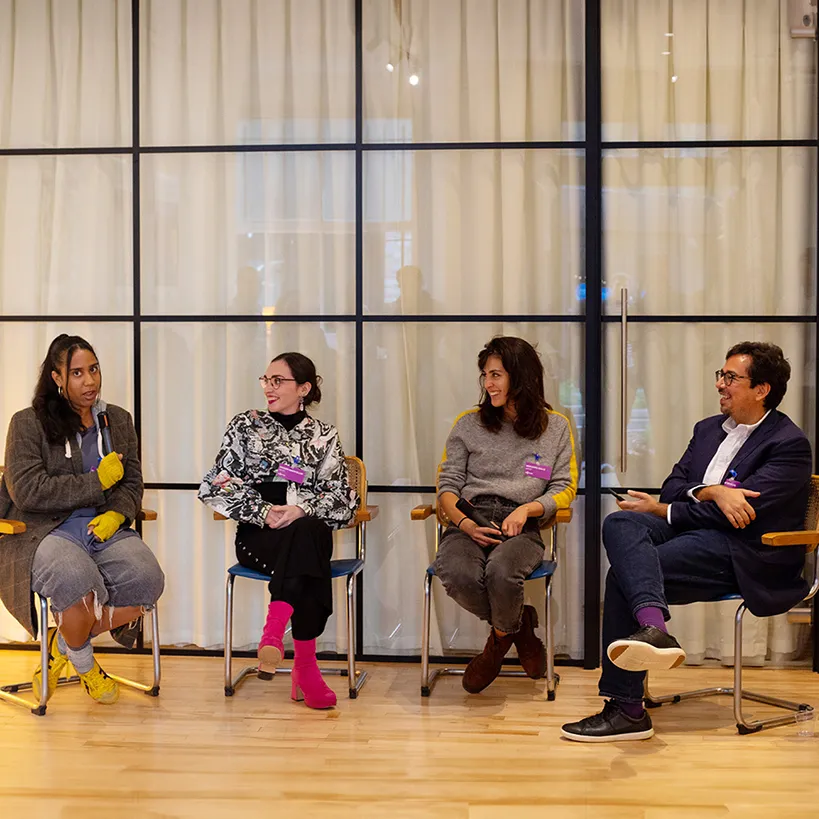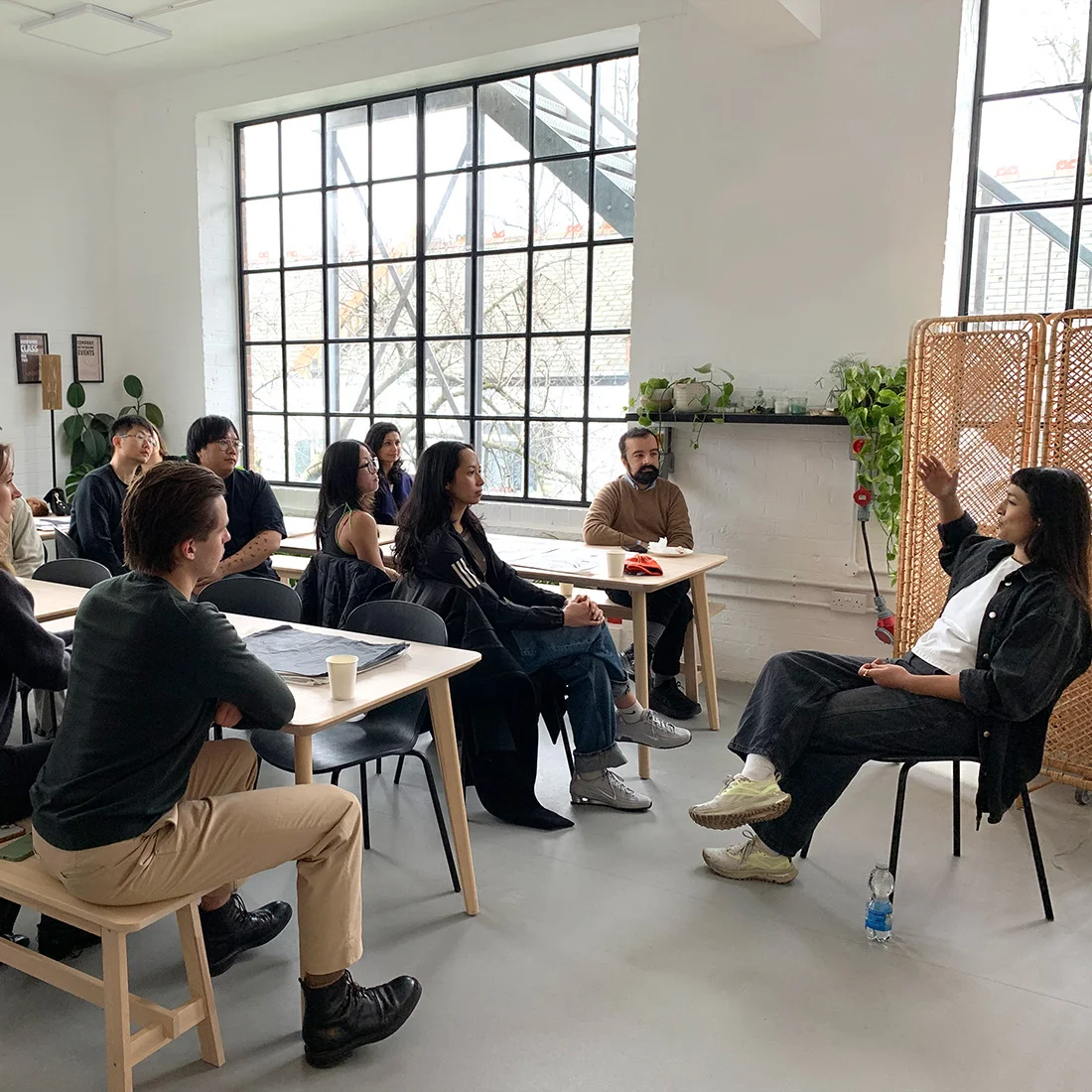

Zarastro Art’s London event in early March for Women’s History Month featured a fireside chat with Imogen Marsteller and Sophia Vigne Welsh. They discussed their artistic practices, exploring themes of gender and identity, as well as the ongoing challenges women face in achieving parity in the art world.
IM: How did you arrive at painting as your main medium?
SVW: I studied photography during my BA and was working on a socially engaged film project. It was a very stressful experience. At the same time, I was going out with a guy who did graffiti. He showed me how to use spray paint, and that became my introduction to painting. My graff career was short-lived, but it really opened something up for me, the expanse of the wall in front of me and the freedom that brought. I started experimenting with found object installations and nontraditional art materials, and that became my focus after graduation.
IM: It is fascinating that you studied photography because I did as well, along with printmaking and drawing. Obviously, I am a painter now, but I felt like my storytelling was lacking in photography. I know there are beautiful works by photographers, but for me, the medium felt cold and dead, whereas painting felt alive. That was just my own struggle and critique.
I ended up switching to painting halfway through a photography class, which felt a bit odd. So, I basically wrapped up my undergrad by making paintings in a photography class. Thankfully, my professors supported me. Since then, I have never looked back. I am too obsessed with paint. With painting it is a continuous battle with the medium. Every work is a new challenge.
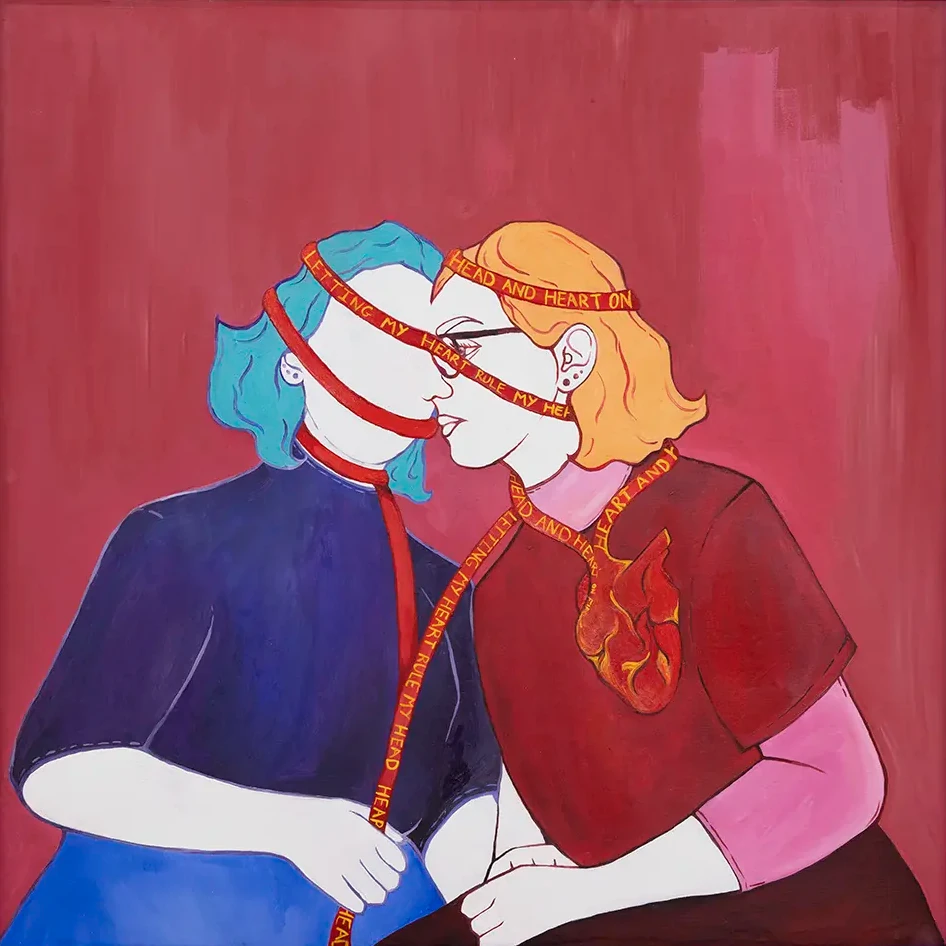
SVW: I think the fact that we both come from a photography background means that composition is so important to us. It is the first thing we consider when approaching a canvas, along with the vibrancy of color. So yes, I can definitely see those connections.
IM: The photography grid—once it is in your head, it never leaves. I also remember when I first met you, I was talking about making a painting about home. A lot of your paintings explore the idea of home?
SVW: Yes, my work has always been about building space and creating a sense of home. It is about exploring different notions of home. So even though our work looks different aesthetically, there is a lot of overlap in theme.

IM: I think it would be really interesting to see our work together. I feel like the colors would complement each other. Even though we are exploring the same themes differently, I wonder if people could see the connection… How has your identity as a woman shaped your artistic process? Or do you resist that framing?
SVW: That is a loaded question. I think I am at a point where I try to take a neutral approach. There was a time when I resisted that framing, but it is what it is. I am a woman, and of course that is going to affect the work I make. But when I am in the studio and in a state of flow, I am not thinking about those things. I also try to think less about it outside the studio. People will always make judgments or assumptions because you are a woman artist, but the less you listen to that, the better.
IM: I think I have taken a more direct approach. My work has become more colorful and vibrant over time, and in the past three years, I have fallen into self-portraiture. It is obvious that it is me in the work. There is a duality—wanting to create something tender and soft but also powerful.
In my own life, I work in a climbing gym, doing a lot of manual labor. Finding steel-toed Cat boots in my size—I am a size 3—was a challenge. I get judgment for doing that kind of work. I feel like it is easy for people to put you into boxes being one thing or the other. Men tell me how to do my job simply because I am a woman, even if I know better and that frustration definitely feeds into my work.
Also, being an American, especially living in New York, has influenced me. I graduated high school in 2016, right when Trump was elected. I started uni that same November at a historically women’s university that emphasized political activism. The anger from that period is embedded in my work. Sometimes I wonder if I should be less angry, but I do not think so.

SVW: I went through that angry period, too but since turning 30, it has dissipated somewhat. But it is good to harness that anger into something productive and it can really drive you.
IM: I am not thirty yet, so I still feel that frustration. When I see the news, I think, how did we end up here? It is like the statistic, though I cannot recall the exact figure—something about women artists selling for 43% less than men. It is shocking, but I sometimes spin it as a selling point: if you buy my artwork now, it is a smart investment. Hopefully, in five years, its value will increase as the world catches up and recognizes that women artists are worth the same.
But that is just part of it. I also came across a statistic from Women in Art Fair stating that only 12% of artists represented by galleries in the UK are women. I am not sure of their sources, but that figure really depressed me.
SVW: Yeah, it is depressing. Very depressing.
IM: Those struggles are still present. We have made progress, but not nearly enough. Anyway… Your work carries a sense of movement and fluidity. Do you feel this challenges rigid narratives about women in art?
SVW: I hope so. My approach to painting has always been non-hierarchical, especially regarding materials and their application. That, in itself, reflects a challenge to hierarchical value systems. I grew up in rural Ireland in the early ’90s with a single mother. Back then, in that place, it was unusual, and we were judged for it. I learned early on how people would talk about us, how we were “othered” in school and social settings. Painting has always been a way to process and explore those emotions. I have always questioned why someone would judge another based on circumstances beyond their control.
IM: You paint on raw canvas, right?
SVW: I do, almost always unprimed canvas.
IM: That rawness adds so much emotion to your pieces. What is shown and what is not feels deeply connected to your themes—like what is spoken and what remains unsaid. It is really present in the works I have seen.

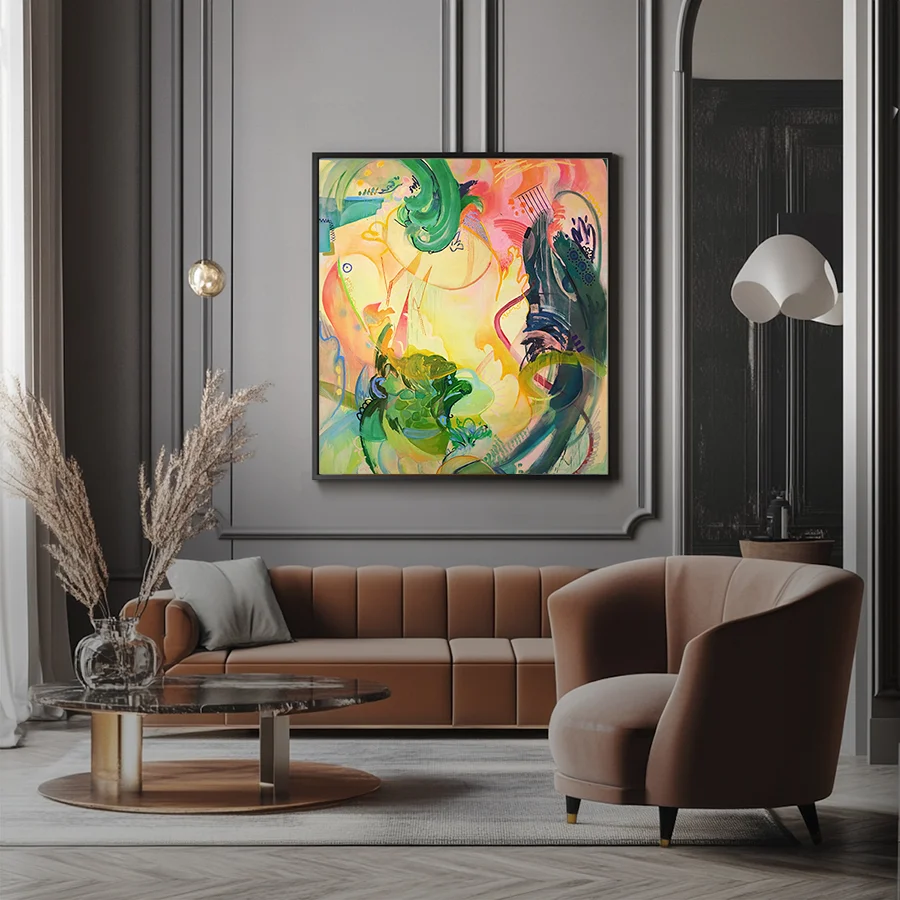
SVW: Absolutely. I am very influenced by the Supports/Surfaces movement. I build my own stretcher bars, and I believe the painting process starts there. The canvas is as much a part of the work as the paint itself. I use everything—cheap kids paint, spray paint, oil, pencil—and I do not assign different values to those materials.
IM: I remember someone messaging me on Instagram, saying they were a bad painter and needed better brushes. I asked what brushes they used, and they sent a picture—they were the same brushes I use! I thought it was such a funny, random message.
SVW: When I first started painting, partly due to finances but also as a sort of test for myself, I decided to use only cheap or found materials. I was learning, and it felt right. When I finally bought a decent brush, it did feel nice, but the learning was in using what I had.
IM: Yeah, I have a mix of brushes too. It is just funny how people think just tools will make the difference. You also need time, dedication and persistence… So, do you feel the art world is shifting in terms of representation, or does it still feel like a closed circle?
SVW: There is definitely been a shift. We would be in denial to say there has not been progress, especially over the last three or four years. There is a growing interest, though real change takes time.
IM: I love going to galleries, and I try to see exhibitions once a week or every other week, particularly seeking out shows by female artists. It is a challenge. Sometimes it is just exhibitions of “ten dead men,” and I think, “I would rather support young artists.” It is not about being anti-male—good art is good art—but I do want to see what my peers are doing.
Have you ever felt pressured to position your work to fit expectations around gender or identity?
SVW: Definitely, especially starting at the RCA. I felt pressure to lean into that. I have become more open about my background, but there is constant pressure to mine your identity and trauma, to commodify it. I try to be cautious about that.

IM: I get that. In institutions, it is tricky. I made a work that was not personal enough, then another that was “too personal.” I felt like I could never win. Now, I focus on what feels true to me. The moment I start thinking about external expectations, I panic, and the work suffers.
SVW: Making work for an audience can kill authenticity. It has to come from your own desires. If you are creating for others, it usually turns out pretty bad. I have done that, and it was awful.
IM: Getting exhibitions is one thing, but what does your presentation in the art world look like?
SVW: That is a hard question. I have been thinking about arts funding a lot. In Ireland, there has been a decrease in funding recently, with internal mistakes that have hurt artists. Less funding means fewer opportunities. I think it is pretty dire here too. It is so important that kids in school feel like they can access art—that is the starting point. More investment in social schemes is essential.
IM: It would be amazing if the States had more support. Starting with education is key. Giving children access to art demystifies museums and helps them see these spaces as for everyone. It builds a shared history with the world, beyond certain types of people.
SVW: Exactly. Many young people may be creatively gifted, but their backgrounds make art seem unattainable. Even considering studying art, let alone pursuing it as a career, feels out of reach.
IM: I relate. I am from Tucson, Arizona, where there is not much of an art history. There are few female artists from there. I knew I had to leave if I wanted to pursue art. My high school defunded art classes by my senior year. There were only four of us in a school of two thousand who wanted to do art. It was not even seen as an option. That was tragic… Do you think social media and digital platforms have changed artist visibility, or do traditional systems still hold the most power?
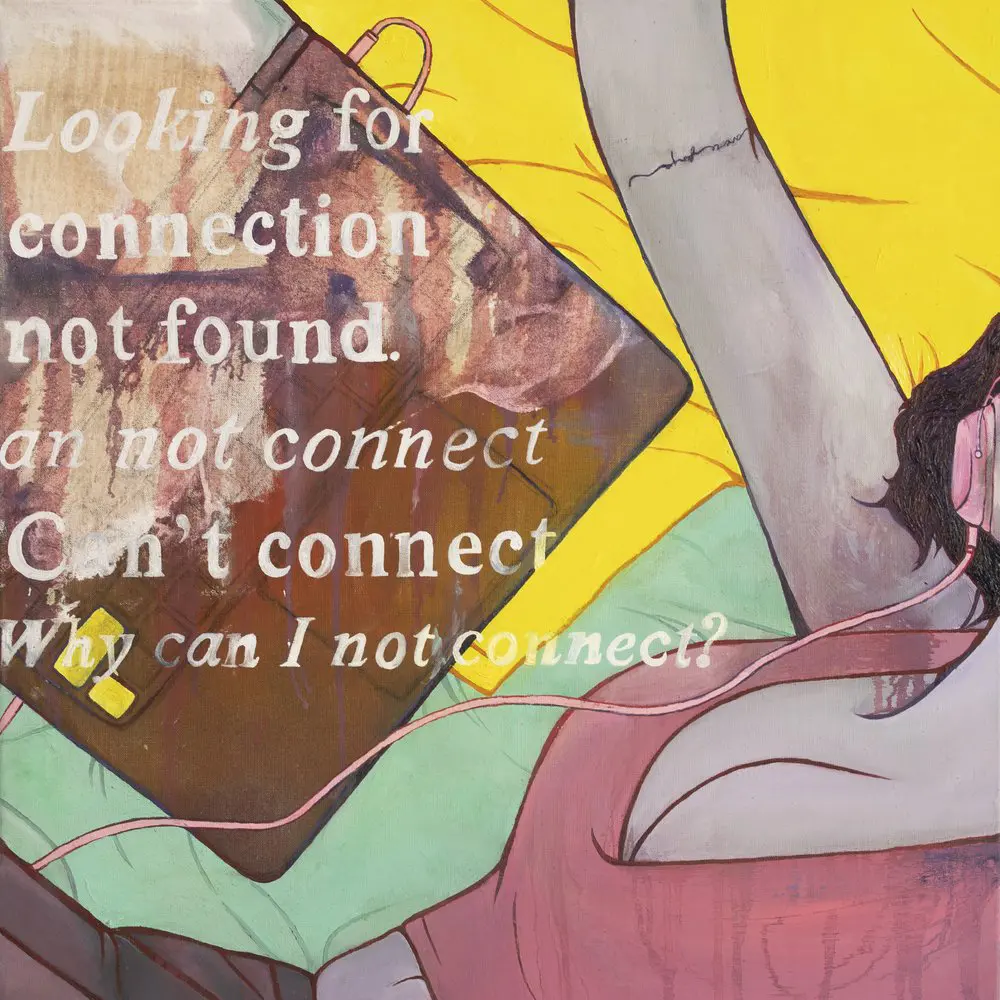
SVW: Social media has definitely changed things. Between 2020 and 2022, I supported myself by selling work through Instagram. I moved to Lisbon, had a studio, and sold work directly. That would not have been possible without social media. But institutions still hold the most power. By the end of 2022, sales dropped massively. It was a nice bubble while it lasted, but sustaining it was difficult.
IM: I started posting seriously in 2020, so I missed that peak. Social media helps with visibility, connecting with artists globally, and seeing what issues we are all addressing. But I agree, power is still with galleries and institutions. Somehow, they have managed to control Instagram—maybe it is a conspiracy theory, but it feels like they influenced the algorithm.
SVW: I started using Instagram in 2016 during my BA. Back then, it was great for discovering artists. When I moved to LA, I would already made contacts through Instagram. Now, the algorithm is terrible—it just feeds the same content.
IM: And so many ads. Plus, the NFT trend—they ask you give them money so they can sell your work for huge amounts. It is frustrating. Do you feel like collectors approach work by women differently than by men?
SVW: It is an interesting question. I have not spoken about it much with male artist friends.
IM: It is worth discussing. If there is a difference, it is important to acknowledge it. I feel like artists should talk more about how collectors approach them. It would help demystify the process.
SVW: Definitely. It is a common conversation with female artist friends. There is often the sense of not being taken as seriously because you are a woman. That is just reality in many areas of life.
IM: Yeah, same.

SVW: We are very open about sales and how collectors approach us and deal with us. It is not something that I have noticed other guys are as open about. Maybe that feeds into the ever-prevalent boys club. Definitely saw that at the RCA.
IM: I think the most fascinating difference between going to a historical women’s college, when you know, we had male students as well—60% women and 40% male—but it was Sarah Lawrence College. It was the first university in America to offer master’s degrees for women, and the first school to offer gender studies as a field. Then going to school in Edinburgh and later Goldsmiths, I noticed the difference in focus. I studied art history as well.
My professors at Sarah Lawrence made a huge effort to talk about female artists. It made sense at the school I went to. The same for all the classes I took—they made sure we included female writers. But then looking at my reading list at Edinburgh and seeing 25 male, white dudes who are all dead, I was like, “Wow!” It is something I did not even think about for four years of undergrad. I did choose that university for a reason, coming from a very different background in Arizona… Anyway, how have you noticed patterns in who buys your work and why?
SVW: I mean, generally, I have found there is definitely more of an interest from the American market in my work. Also, German collectors. I think a lot of London collectors play it very safe. But I also think that, because of the year I spent in L.A., my painting is so influenced by contemporary American painting. Artists like Laura Owens, Joe Bradley, and Matt Connors.
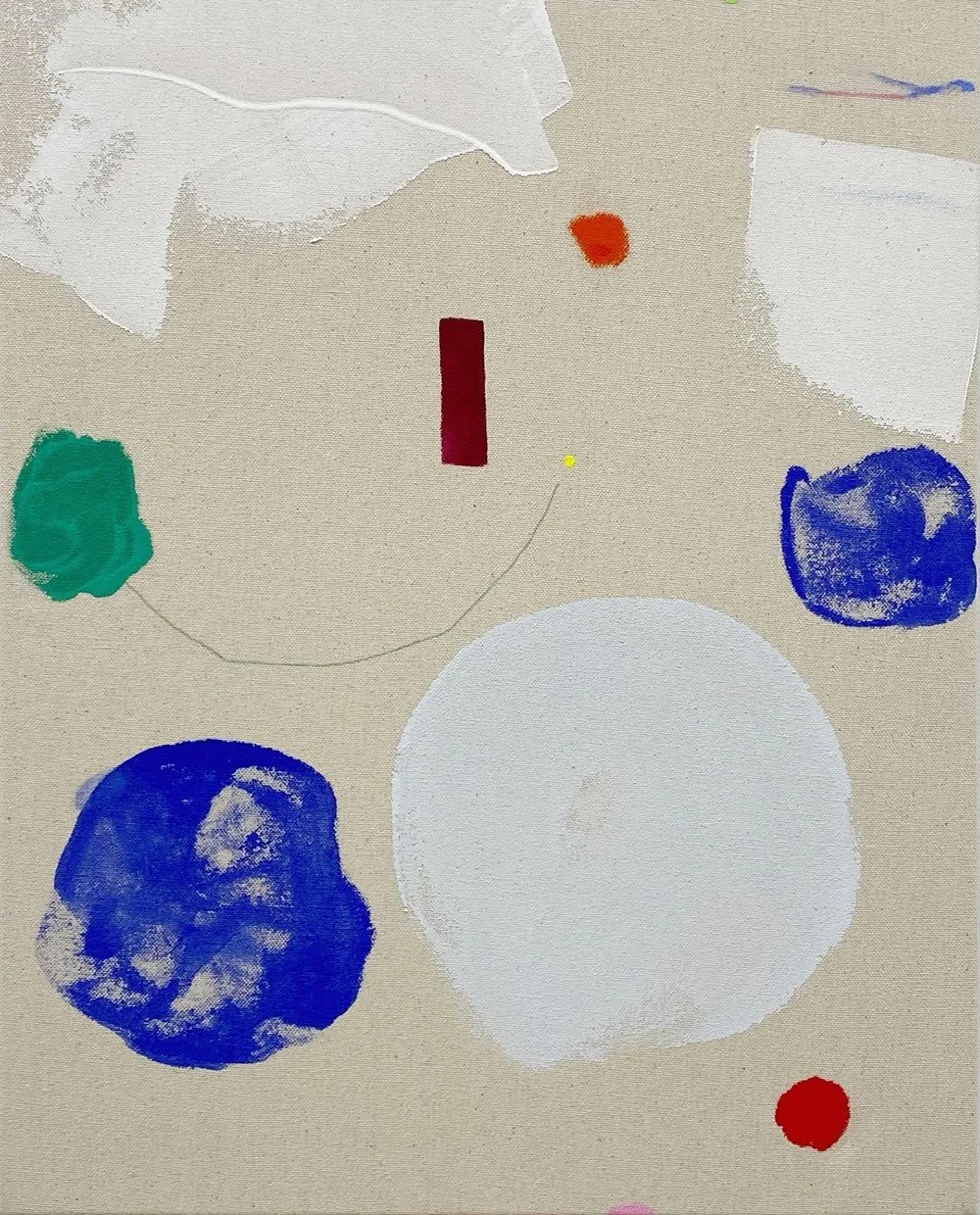
IM: That is interesting. I never thought about nationality that way. For me, it has always been, sometimes people who are really interested in film, which makes sense, and other times, I think it is people who have heard me speak about my views on feminist history. I really like having women like my art, and that is always nice. But I never really thought much about what type of people are drawn to it.
In general, my work seems to resonate with both women and men, which makes me quite happy. Although, I do have a few paintings that I think would be hilarious if a businessman bought them. I would jack up the price by 150%, and then have it hung in some office building. All the finance bros would see it every day. That would be fascinating. That would be kind of like, “Hee hee hee.” Anyway… Post-MFA – what has been the most unexpected challenge in building your career?
SVW: Hmm, I think because I took such a big gap between my B.A. and M.A.—it was seven years—I was painting full time for about two years before I started my M.A., so I was pretty aware of the reality of what an M.A. would or would not do. I was not expecting it to be some sort of magic thing that would make me an overnight success. It just felt like the next appropriate step in my career. So, yeah, it has just been back to reality, out of the bubble of education, which is a really nice place to be for a year.
IM: I loved the bubble of it. I mean, Goldsmiths was two years, which is why I chose it. I really wanted time to develop my work. I think the MFA gives you that time—and the funding—to just have time. I moved to the UK about four or five months before I started my MFA, so that was in 2021. There were still tons of restrictions in the country when I moved here. You still had to quarantine, but weirdly I did not have to because I had been living in Iceland for a year, which is a bit of a random story.
So, my first five months in the UK was just me working, trying to find somewhere to live, and then settling in. My experience living in London has entirely been shaped by that. Coming out of the MFA bubble, I knew what reality was like because I had a gap between mine, but not reality in the UK. I had not experienced that as an adult before. That has been an interesting challenge—trying to find that sense of community again. The MFA community really dissipates quickly; everyone moves back to wherever they are from, and everyone is busy with part-time work or life stuff. That has been the hardest part for me.
SVW: I totally agree.

IM: So, what role do artists play in shifting the conversation versus institutions and collectors?
SVW: I think emerging artists honestly do not have a huge voice in that conversation. Sadly, it really does come down to the institutions and the people at the top to implement and make changes. Maybe mid-career or established artists have a bit more influence, but as an emerging artist, you have to take all the opportunities you can get, and sometimes that means working with people or institutions you might not feel great about. You have to do it to further your career. I would hope that the further along you get, the more discerning you can be.
IM: Yeah, I think it is also like… Not hating on Zarastro Art, by the way…
SVW: Obviously, obviously!
IM: Because they are really lovely and they are awesome, just to make that very clear, before I say everything I am about to say. I think it can be quite difficult to feel like you have a voice within an institution. I think you have a voice as an artist, and I want you to have a voice as an artist, as long as it is not too political, as long as it is not too critical of the institution. You need to be careful. I am also quite blunt as a person. Maybe it is that American vs British thing, or maybe it is my personality. I just have a bad habit of saying what I think, and that can get me in trouble with these institutions. If I see some bullshit, I will call it out. That can get me into big trouble, and that should not be the case.
SVW: No, no, no.
IM: And then the last question: what does real progress look like in terms of representation?
SVW: That is a big one. It makes me think again about funding, government funding, access to education and the arts from a young age. That is always going to be my starting point—funding.
IM: What I find fascinating about funding is that I did not know it existed until I moved to the UK and heard about my European friends getting funding. I was like, what? I just have federal government loans from the US. I was mind-blown that it was even a thing. It was such a different concept. It was like, “Oh, that is cool!”
SVW: I mean, there was a trial in Ireland where artists received a weekly stipend. It is actually in its final year now. It is a universal basic income for artists, but it is not a lot. It is about 350 euros a week, which honestly is not livable if you are trying to make rent. The housing crisis in Ireland is insane at the moment. Rent is worse there than in London. But it is a pilot scheme, and we are hoping it will continue. It has allowed a lot of people to develop their practices, and I think it should just be a given once you can show commitment to your practice. The amount of unpaid work we do is unfathomable. People might see an artist selling a painting for ten grand, which is amazing, but if you break down the hours spent on it, it is always so much less than minimum wage.

IM: I heard that last year the average artist in the UK gets paid two pounds an hour for their work, which is abysmal. It just made me feel really shit. Every time I have to price my work, I feel physically ill. I once went through how much I was getting paid per hour, and I just wanted to cry, curl up in a ball, and then quickly move on. The next day, it was like, “Okay, whatever.” It is not why I am doing this, though. And that is a misconception—artists are not doing this to get rich. There is no one way.
SVW: Anyone who comes in without a credit card is going to get a pretty quick wake-up call.
IM: Yeah, I had someone tell me—who did not know me very well—that they wanted to become an artist because my lifestyle looked great. And I was like, everything looks great on Instagram. I spend hours posting beautiful posts on Instagram, but you have not seen the reality of it all, the truth behind the glimmer of Instagram.
—
The transcript has been edited and condensed for clarity.