Christie’s spring sales in New York offered a stark picture of today’s art market, generating more than $1.1 billion in a single evening while resetting records for Jackson Pollock, Constantin Brancusi, Mark Rothko, and Joan Miró. The results confirmed continued demand for rare, museum-quality works.
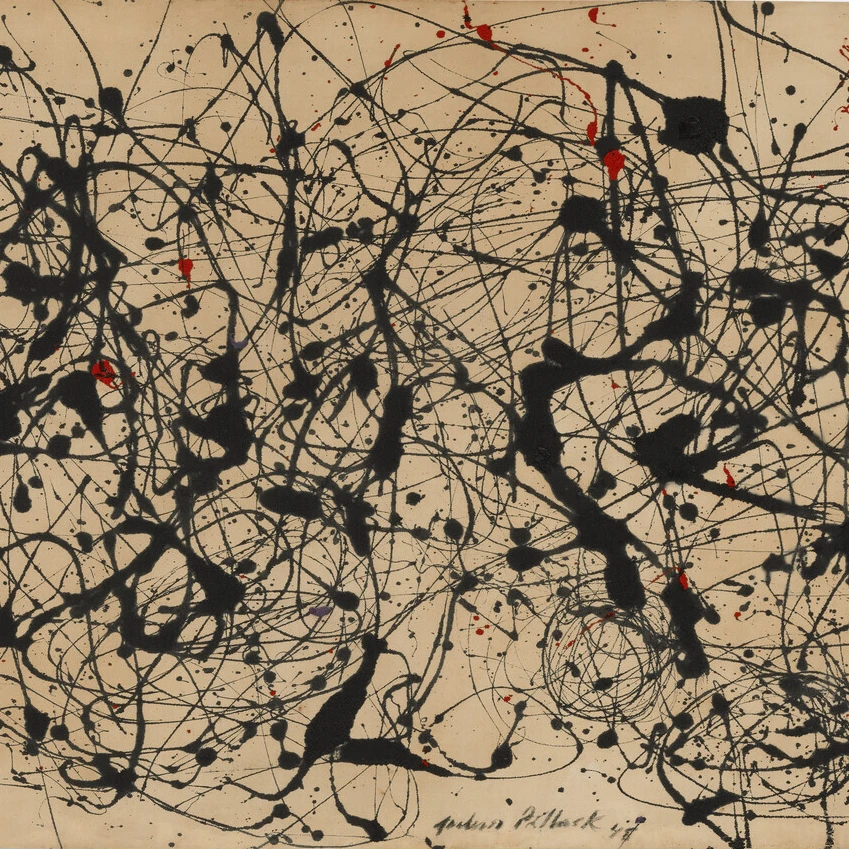
The defining moment of the week was Jackson Pollock’s Number 7A (1948), which sold for $181.2 million from the collection of media magnate S.I. Newhouse. The result nearly tripled the artist’s previous auction record and placed the painting among the most expensive works ever sold at auction.
Created when Pollock was 36, the monumental canvas marked a decisive shift in his practice. Produced on the floor of a barn near East Hampton, the work became one of the earliest and most significant examples of his drip technique. Christie’s described it as one of the first truly abstract paintings in the history of art.
The sale itself carried an unusual level of anticipation. Estimated at $100 million, the painting sparked a six-way bidding battle before selling to a phone bidder represented by Christie’s global president Alex Rotter. Speculation before the auction even suggested the work could challenge Leonardo da Vinci’s $450 million auction record. Although it remained far below that figure, the result reinforced the strength of demand for exceptional postwar masterpieces.
Newhouse’s collection dominated the evening overall. Sixteen works achieved $630.8 million in under an hour, with every lot sold. Alongside Pollock, Constantin Brancusi’s Danaïde (1913) realised $107.6 million, becoming the second most expensive sculpture ever sold at auction. The bronze had previously belonged to Eugene and Agnes Meyer, two of Brancusi’s closest patrons, before Newhouse acquired it in 2002.
Joan Miró’s Portrait de Madame K (1924) also established a new auction record for the artist, selling for $53 million. Elsewhere in the sale, works by Pablo Picasso, Francis Bacon, Jasper Johns, and Andy Warhol attracted strong bidding, contributing to one of Christie’s most successful auction nights in recent years.
The momentum continued in Christie’s subsequent 20th Century Evening Sale, led by Mark Rothko’s No. 15 (Two Greens and Red Stripe) (1964), which sold for $98.4 million and established a new record for the artist at auction. The painting came from the estate of philanthropist Agnes Gund, who had acquired the work directly from Rothko during a studio visit in 1967.
Additional records were set for Alice Neel, Remedios Varo, Henri Matisse works on paper, and Aleksandr Rodchenko. Yet despite the headline figures, the broader market appeared less euphoric.
Christie’s later postwar and contemporary sales delivered respectable but uneven results, led by Gerhard Richter’s Kerze (Candle) at $35.1 million and a Donald Judd stack sculpture at $12.8 million. Several works by established artists sold below estimate, including pieces by Andy Warhol, Richard Prince, Mark Bradford, and Eric Fischl.