Gagosian Seoul presents Kawaii Summer Vacation, featuring new paintings and sculptures by Takashi Murakami in central Seoul. The exhibition explores his iconic floral motifs across diverse media and techniques, connecting the laughing flower to the natural forms of nihonga, the traditional Japanese painting style that shaped his early work.
Kawaii Summer Vacation marks Murakami’s return to South Korea after MurakamiZombie, a major retrospective at the Busan Museum of Art in 2023, and is his first solo show in Seoul since Superflat Wonderland at the Samsung Museum of Art’s PLATEAU in 2013.
The exhibition revisits motifs first introduced in 1995, reflecting Murakami’s “Superflat” aesthetic, which merges traditional techniques with popular imagery on a flat plane, drawing from anime, manga, otaku culture, and the kawaii sensibility.
Floral icons appear across his print, film, digital work, commerce, painting, and sculpture, often alongside characters like Mr. DOB, highlighting his engagement with both historical and contemporary forms and the global art market.
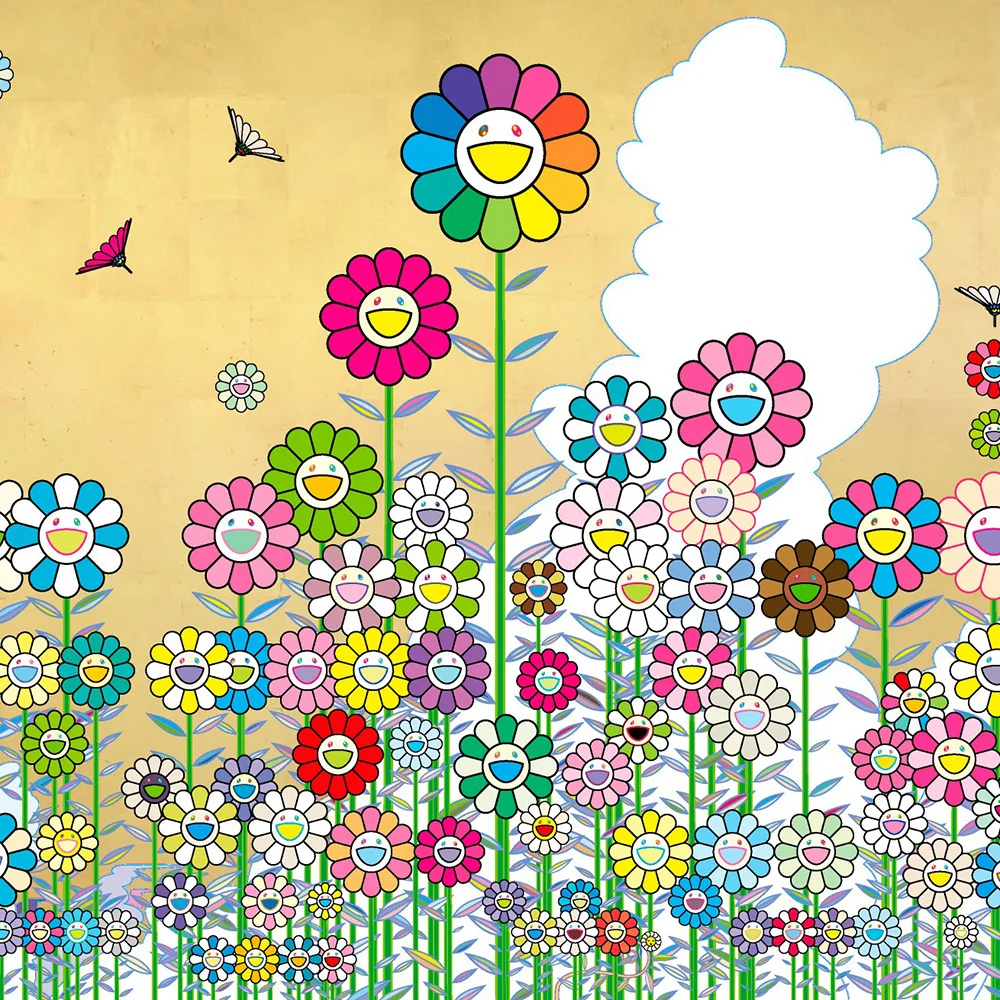
Whether shown as lone, iconic portraits or intricate constellations, Takashi Murakami’s flowers combine technical precision with approachability. They radiate happiness, resilience, and hope while subtly critiquing late-capitalist consumerism and taste.
Summer Vacation Flowers under the Golden Sky (2025), the exhibition’s focal point, features a panoramic landscape with a kaleidoscope of flowers scattered on a partially gold-leaf ground embossed with skulls.
In Tachiaoi-zu (2025), Murakami draws on Japan’s past through a reinterpretation of a Kiku-zu screen by Rinpa master Ogata Korin (1658–1716), with red, pink, and white hollyhocks set against gold leaf.
Finally, two sculptures from 2024 that are both titled Hello Flowerian show a small figure on a pedestal holding a flower. Bright polychrome paint is used to finish one sculpture, while reflective gold leaf is used for the other.
Even though these characters appear to be as happy as the other pieces on display, their innocent portrayal conceals a deeper reality that captures Murakami’s awareness of the psychological, social, and economic unpredictability facing postwar Japan.
Takashi Murakami, who was born in Tokyo, Japan, in 1962, is renowned for creating a world that combines anime, consumer culture, and traditional Japanese art traditions into what he dubbed “Superflat.” He received training in Nihonga painting at Tokyo University of the Arts, where he reinterpreted the discipline’s painstaking methods in a hyper-saturated, global visual language.